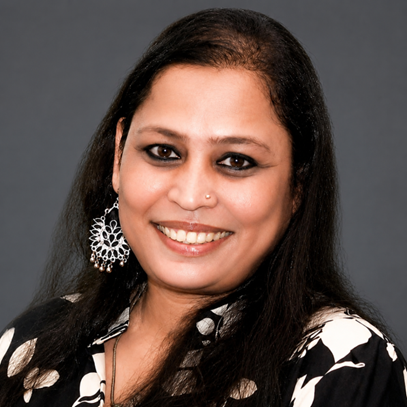
Satyabhama Majhi is an Indian contemporary visual artist, curator, social activist and community art practitioner based in Bhubaneswar, Odisha. Working across painting, sculpture, installation, photography, mixed media, public art and community-based practice, she has developed an artistic language that connects contemporary expression with cultural memory, indigenous knowledge, ecology and everyday life.
Active since the early 2000s, Majhi’s practice extends beyond the traditional gallery environment. Her work encompasses exhibitions, artist residencies, workshops, public murals, educational programmes and long-term community engagement. Among the recurring concerns in her work are urban transformation, relationships between people and places, cultural identity, environmental change and the preservation of collective memory.
Early Life and Artistic Influences
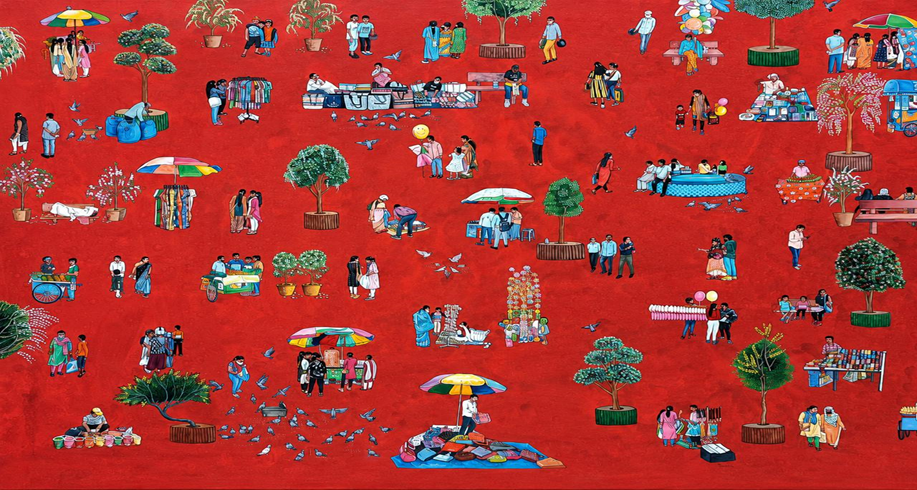
Majhi grew up in Bhubaneswar, Odisha, where her observations of everyday city life became an important foundation for her artistic practice. During her childhood, she spent time observing the activities surrounding her father’s shop in a local marketplace. The market provided an everyday view of human interaction—people buying and selling, seasonal celebrations, neighbourhood relationships, animals and the constant changes taking place around them.
These early experiences developed her interest in the relationship between people and their surroundings. As Bhubaneswar itself changed over time, Majhi became increasingly interested in disappearing spaces, cultural memories, urban development and modernization.
Education and Multidisciplinary Practice
Majhi holds a Master of Fine Arts (M.F.A.) in Traditional Art. Although her academic background is rooted in traditional artistic practice, her professional career has developed into a multidisciplinary approach.
Her artistic fields include painting, sculpture, installation art, photography, mixed media, public art, site-specific projects and community-based art. She has also incorporated art education and creative learning into her practice.
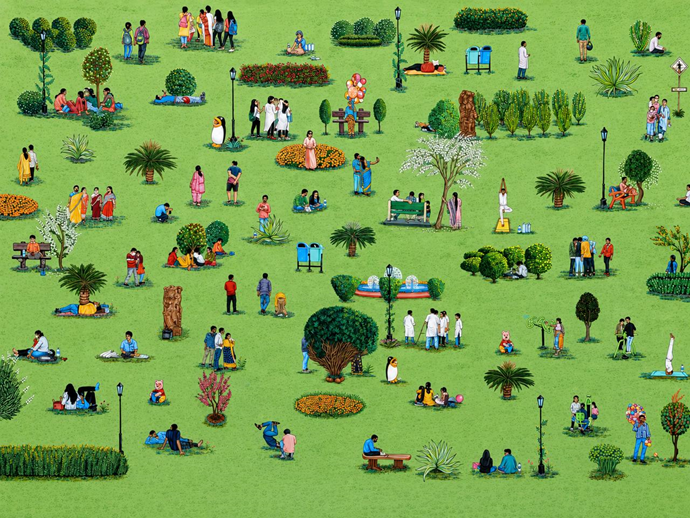
Her paintings frequently bring together groups of people, animals, plants, architecture, vendors and other elements of everyday life. Rather than focusing only on an individual subject, her compositions often present a broader social environment, creating visual narratives around collective experiences.
Urban Life, Memory and Transformation
Urban transformation is one of the important themes in Majhi’s work. Her experience of watching Bhubaneswar develop has encouraged her to consider cities not simply as physical spaces filled with buildings and roads, but as environments containing memories, relationships and histories.
Her visual work explores what happens when familiar neighbourhoods change, when traditional environments disappear and when modernization alters established patterns of everyday life.
People walking, working, selling, waiting, celebrating and interacting with their surroundings appear repeatedly in her visual language. Through these figures and environments, she explores the connection between individual experience and collective memory.
Engagement with the Dongaria Kondh Community
A significant dimension of Majhi’s artistic journey has been her sustained engagement with the Dongaria Kondh community of Odisha. Her documented engagement with the community extends for more than a decade and has involved observation and interaction concerning cultural practices, livelihoods, indigenous visual traditions and relationships with the natural environment.
The Niyamgiri hills have played an important role in this artistic exploration. Majhi has examined connections between landscape, livelihood, spirituality and cultural identity, while exploring visual traditions associated with the community and references connected with Niyam Raja.
This engagement has influenced both the themes and materials of her artistic practice. Rather than treating indigenous culture simply as a subject for representation, her approach places emphasis on observation, listening and understanding the environmental and cultural context from which particular artistic forms emerge.
Natural Pigments and Niyamgiri
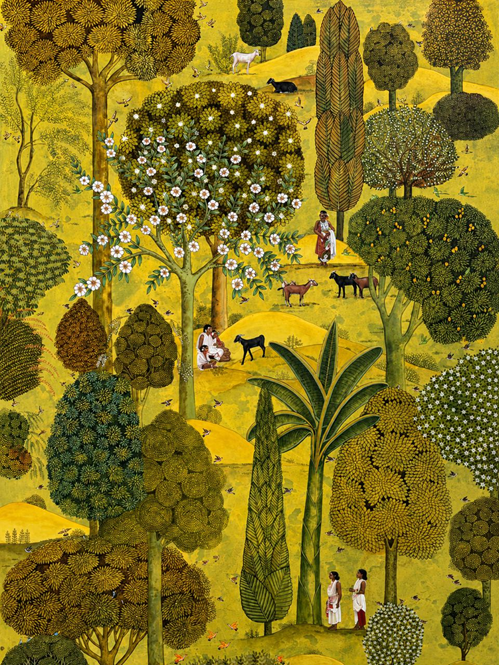
Majhi has experimented with natural materials associated with the Niyamgiri region. Her interest in indigenous wall-painting traditions and naturally sourced colours led her to explore materials including chalk stone, charcoal, turmeric, geru soil and brown stone.
These materials can be processed into pigments and used with binding materials for artistic work. In this approach, the landscape itself becomes part of the physical construction of the artwork.
Her experiments with natural pigments reflect a wider interest in the relationship between material, geography, cultural memory and artistic expression.
The Triangle Motif and “Up and Down”
The triangle is a recurring form in some of Majhi’s works influenced by Dongaria Kondh visual culture. Within her artistic exploration, triangular forms are associated with the silhouette of the Niyamgiri hills and ideas connected with landscape, stability, sacred geography and divinity.
Another conceptual exploration emerging from her observations of Niyamgiri is “Up and Down.” The everyday movement of people travelling uphill and downhill through the hills became a metaphor for human life and the continual movement of individuals and communities in response to changing circumstances and opportunities.
People’s Wall and National Public Art
In 2023, Majhi served as a Co-Sutradhar and creative contributor to People’s Wall – Jan, Janani and Janmabhumi, a participatory art project created for the New Parliament House in New Delhi through the Lalit Kala Akademi.
The project brought together women artists and artisans from different parts of India, incorporating regional aesthetics, traditional visual languages and the knowledge of women practitioners.
For Majhi, the project represented a convergence of several elements central to her career: collaboration, community participation, traditional culture and contemporary public art.
Public Art and Community Projects
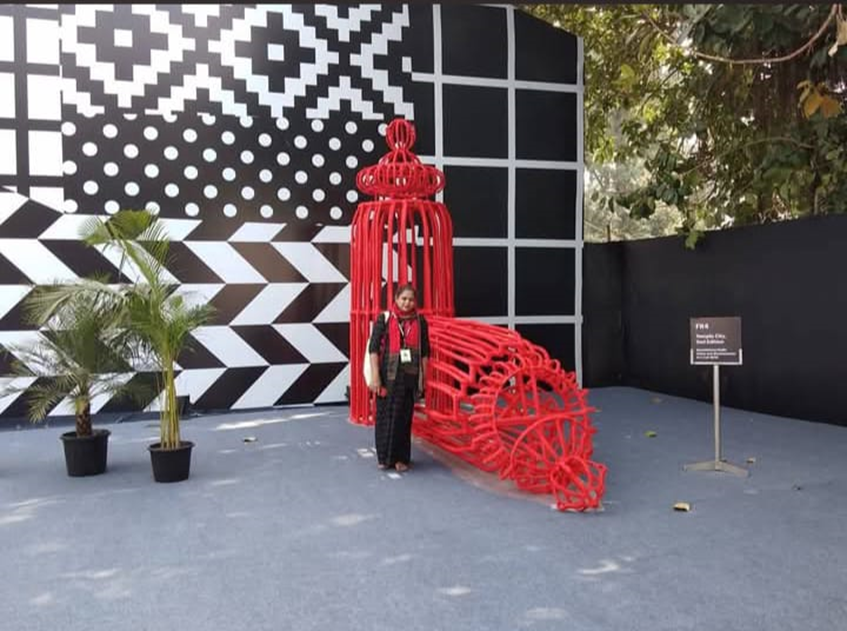
Public art occupies an important place in Majhi’s career. She has participated in large-scale murals, public-art interventions and community projects in Odisha, including activities in Cuttack and Bhubaneswar.
Her public-art engagements include projects associated with Ring Road and Dagabara Sahi in Cuttack, as well as murals connected with major sporting and cultural events, including the Men’s FIH Hockey World Cup and Asian athletics events. Her documented projects also include Pago and Thought Loom.
Her approach transforms walls and public spaces into places where communities can encounter visual culture outside conventional galleries.
Art Education and Work with Children
Education and creative learning have been another important component of Majhi’s career. For approximately 15 years, she has worked with children, schools and educational communities through art-based initiatives.
Her approach encourages children to draw inspiration from their own memories and surroundings rather than simply copying predetermined images. Activities have explored subjects including household life, trees, animals, festivals, village journeys, nature and personal experiences.
She has been associated with programmes including Kalpanadham and projects involving organisations such as Gram Vikas and Tata Trust. Her educational activities have included workshops with residential schools, children’s festivals and initiatives involving underserved communities and children with disabilities.
Recognition and Artistic Career
Majhi’s professional career includes exhibitions, artist camps, residencies, workshops and community projects. Her documented artistic engagements include Bharat Bhavan, Bhopal; Nature Morte, Gurgaon; Lalit Kala Akademi; Odisha Lalit Kala Akademi; Bhubaneswar Art Trail; Gram Art Project; and Vancouver Biennale-linked projects.
Her recognitions include the Odisha Lalit Kala Akademi State Award in 2012 and the National Lalit Kala Akademi, New Delhi Scholarship for 2009–2010.
Artistic Philosophy and Continuing Practice
At the heart of Majhi’s practice are four closely connected ideas: memory, community, nature and cultural continuity.
Her work examines how places carry memories, how communities interact with their environments and how traditional knowledge can continue to participate in contemporary artistic life. Her career moves between urban and rural environments, gallery spaces and public places, individual observation and collective experience.
As Secretary of the Sasatwa Foundation, Majhi also connects her artistic activities with community and social engagement.
From her early observations of Bhubaneswar’s marketplaces to her long-term engagement with Niyamgiri and the Dongaria Kondh community, Satyabhama Majhi’s artistic journey reflects a continuing effort to understand the relationship between people, place, culture, environment and memory.
Her work demonstrates how contemporary art can extend beyond the gallery—to schools, villages, public walls, community spaces and cultural environments—while creating opportunities for dialogue between traditional knowledge and contemporary artistic expression.