Before its first commercial flight ever took off, Navi Mumbai International Airport (NMIA) told the story of its arrival in two quiet but powerful gestures, one in the night sky, and the other on the terminal floor.
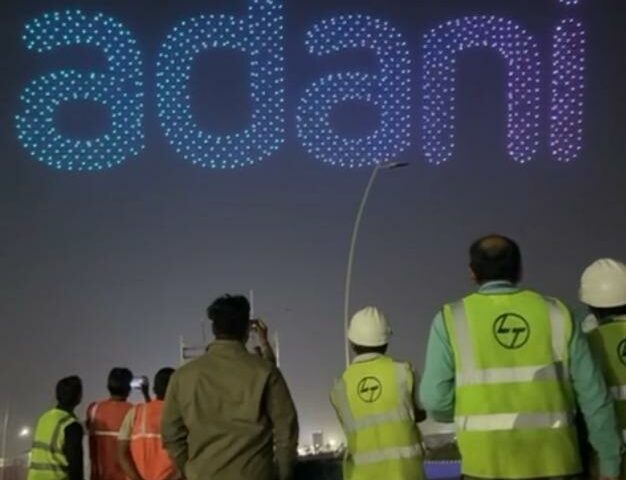
On the evening of December 24, days ahead of the start of commercial operations, NMIA hosted a private drone light show within the airport premises. The event was not announced, not publicised, and not designed as a launch spectacle. There were no dignitaries, no VIPs, and no media presence. Instead, the audience consisted solely of those who built the airport construction labourers, project and ground teams, airport staff, members of the Mitti Café team including persons with disabilities, and children from the workforce community.
For many in attendance, it was their first experience of a drone show. Workers who had spent years across construction zones stood together, watching the sky above transform into a visual narrative of the space they had helped create. The atmosphere was reflective and deeply human, far removed from the usual pageantry associated with large infrastructure milestones.
The drone formations traced NMIA’s identity and vision. A three-dimensional lotus bloomed in the night sky, symbolising growth and resilience and echoing the airport’s lotus-inspired architecture. This transitioned into the Adani Swirl and visuals inspired by the terminal interiors, followed by imagery highlighting NMIA as a green airport, symbolically powered by solar energy. The sequence went on to depict NMIA’s multimodal connectivity—air, road, rail, high-speed rail, and maritime routes converging at a single hub—before expanding into representations of Mumbai, India’s domestic air network, and global connectivity.