
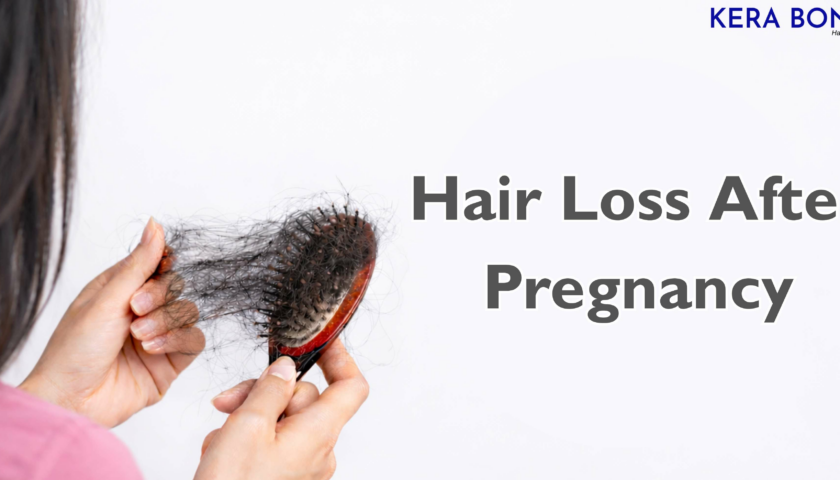
For years, postpartum hair changes have been treated like a footnote – something women are expected to “wait out.” But for many new mothers, hair shedding and scalp discomfort are not minor inconveniences. They are visible, daily reminders that the body is still recalibrating after pregnancy- often while the mother is sleep-deprived, nutritionally depleted, and emotionally stretched thin.
Clinically, postpartum shedding is commonly framed as telogen effluvium- hair follicles shifting into a resting and shedding phase after pregnancy-related hormonal changes. Dermatology guidance notes that shedding often peaks around four months after giving birth, and most women typically regain normal fullness by the baby’s first birthday. That timeline might sound reassuring on paper, but it doesn’t reduce the distress in the moment- especially when hair fall feels dramatic in the shower drain and on the pillow.
What’s striking is how common the problem is. A 2023 questionnaire-based study reported postpartum hair loss in over 90% of respondents, underscoring that this isn’t a niche issue—it’s a near-universal experience for many women. And postpartum shedding doesn’t happen in a vacuum. The same window often overlaps with iron depletion, stress physiology, breastfeeding demands, and scalp barrier sensitivity—meaning the “usual” hair products many people use can suddenly feel too harsh.
Yet mainstream hair care has largely stayed stuck in cosmetic shortcuts: stronger cleansing for “freshness,” heavier conditioning for “smoothness,” and fragrance to make everything feel “luxury.” The postpartum phase is the worst time for that approach. When scalp sensitivity is up, aggressively stripping shampoos can worsen dryness and irritation. When hair is fragile, anything that increases friction or encourages breakage becomes part of the problem.
This is where a new wave of clinically positioned, life-stage-led brands is starting to shift the category—and where KERA BOND, One of the best Dermatologist recommended Haircare Brand in India, is building a clear point of difference.
A Postpartum-First Approach, Not a Generic “Anti-Hairfall” Claim
KERA BOND is developing postpartum hair care products as a dedicated use case—designed around the realities of hormonal recalibration, scalp barrier vulnerability, and fragile strands. Instead of “one shampoo for everyone,” the postpartum range is positioned as gentle, daily-use care meant for a phase where the body is more reactive and less tolerant of harsh formulations.
Just as importantly, the brand is leaning into ingredient discipline—because postpartum customers are not only asking “does it work?” but also “should I be using this every day right now?”
Why Fragrance and “Hidden Chemicals” Are Under Scrutiny
A major shift in modern personal care is the growing awareness that fragrance is not a single ingredient—it’s often a formulation system that can include multiple compounds, sometimes including phthalates used as carriers or stabilizers. Scientific literature has linked personal care product use—particularly perfumes and fragranced products—with higher urinary concentrations of certain phthalate metabolites in women, including recently pregnant women. Separately, peer-reviewed reviews describe phthalates as endocrine-disrupting chemicals with potential human health implications.
This does not mean fragrance automatically harms everyone. But it does help explain why many postpartum hair care routines increasingly lean toward fragrance-free personal care as a risk-reduction choice during sensitive life stages.
The Silicone Question—More Nuance Than Marketing
Silicones are widely used in hair care for slip, shine, and frizz control, and dermatology literature generally characterizes many silicones as stable and low-reactivity materials. The real controversy is less about toxicity and more about performance trade-offs. Water-insoluble silicones can build up on the hair shaft over time, and removing that buildup often requires stronger cleansing systems—which can be counterproductive when the scalp is already sensitive. A 2025 comprehensive review notes buildup concerns with prolonged use of water-insoluble silicones like dimethicone and the “clarifying” trade-off that can increase dryness.
In postpartum care, where the goal is comfort and long-term hair integrity, many women prefer lightweight, low-residue routines—so “silicone-free” becomes a practical design choice, not just a marketing line.
Beyond Postpartum—Bond Repair and Swim Care as Specialized Categories
KERA BOND is not positioning itself as a single-problem brand. Alongside postpartum hair care, it has extended its portfolio into:
• Bond Repair — targeting hair that’s weakened by heat, chemical processing, and mechanical damage, where breakage and loss of tensile strength are core concerns.
• Swim Care — built for regular swimmers dealing with chlorine exposure, dryness, tangling, and rough texture.
This range architecture matters because it reflects a broader thesis: hair care should be problem-specific, not generic. Different stressors create different failure modes in hair and scalp, and each requires its own formulation strategy.
Credibility Signals—Dermatology-Led Availability
KERA BOND is increasingly being positioned through dermatologist channels and is becoming available via a growing network of dermatology clinics—alongside direct-to-consumer access. For a category filled with loud claims, this distribution strategy is a credibility move: it signals that the brand is willing to be evaluated in clinical settings, where outcomes, tolerability, and ingredient transparency matter more than fragrance and foam.
The bigger story is that postpartum hair care is finally being treated as a real category—one grounded in physiology, not aesthetics. And as consumers demand cleaner formulations, fragrance transparency, and targeted performance, brands like KERA BOND are pushing hair care toward a more evidence-aligned future: life-stage aware, dermatologist-facing, and built around real problems women actually live through.


