
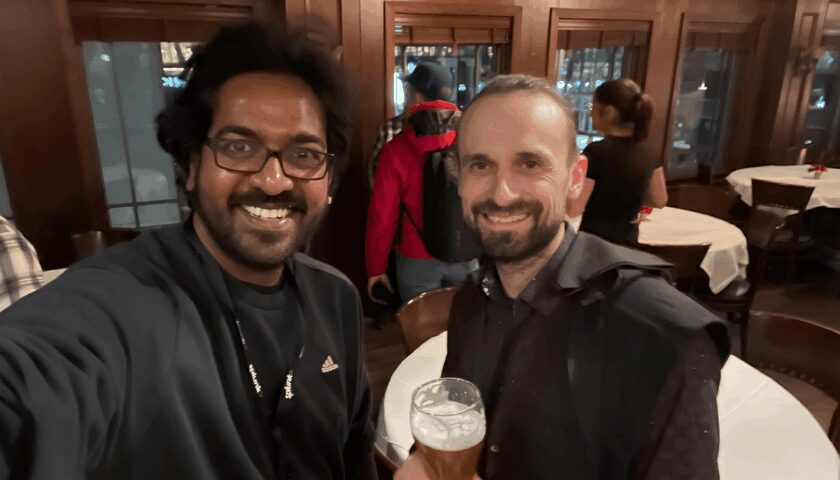
In an era where startups are often defined by speed, spectacle, and short-term traction, Sivakumar Gingee represents a different kind of founder. His journey—marked by uncertainty, deliberate restraint, and long-horizon thinking—offers a case study in how clarity and conviction are forged not in comfort, but in chaos.
As the founder of Bery.in, Sivakumar Gingee is not attempting to ride the next technology wave. Instead, he is rebuilding something far more fundamental: trust as digital infrastructure.
“Clarity isn’t found in quiet rooms. It’s earned in the noise,” Gingee says—a principle that has shaped both his leadership philosophy and Bery’s architecture from day one.
Sivakumar Gingee’s Early Confrontation With Chaos
When Sivakumar Gingee began shaping the early ideas behind Bery, the digital landscape was already crowded with bold promises. Web3 platforms claimed decentralization. Financial technologies promised inclusion. Yet, beneath the surface, Gingee identified persistent structural failures: fragmented systems, weak accountability, and a widening trust deficit between users and technology.
There was no polished pitch deck or guaranteed funding at the outset. What Gingee had instead was conviction—an intuition that trust, not novelty, would define the next generation of digital platforms.
Rather than waiting for perfect conditions, Sivakumar Gingee chose to build in uncertainty, believing that foundational clarity could only emerge through friction.
Cutting Through the Noise: Sivakumar Gingee’s Systemic Lens
The early entrepreneurial phase for Sivakumar Gingee was defined by relentless iteration. Ideas were tested, rejected, and rebuilt. Collaborations dissolved. Assumptions were challenged. Progress was uneven but intentional.
During this period, Gingee focused on diagnosing broken systems rather than chasing trends:
● Financial rails that excluded millions rather than empowering them
● Blockchain protocols that prioritized openness without accountability
● Platforms driven by speculation instead of long-term human utility
For Sivakumar Gingee, the issue was not technological capability. It was architectural intent. Digital systems were designed to be used—not to be trusted. And that distinction, he believed, would become increasingly costly over time.
From Questions to Blueprint: The Bery Architecture
Out of this chaos emerged clarity. Each failed direction helped define what Bery would not become. Gradually, Sivakumar Gingee distilled the company’s foundation into three principles:
- Trust is the core currency of digital ecosystems
- Infrastructure must outlast hype cycles
- Vision has no value without disciplined execution
Under Gingee’s leadership, Bery evolved into more than an application. It became a platform designed as core infrastructure—supporting secure identity, transparent financial interactions, and trust-first digital relationships.
“You can’t build the future by asking permission from the past,” Sivakumar Gingee often says. This mindset informed Bery’s decision to build its own rails rather than depend on fragile, trend-driven layers.
Conviction Over Speed: How Sivakumar Gingee Chose Longevity
Once clarity was established, Sivakumar Gingee shifted fully into execution mode. Bery’s roadmap emphasized layered, resilient architecture rather than rapid expansion. Identity systems, accountability frameworks, and economic interactions were designed with durability in mind.
In a startup culture obsessed with velocity, Gingee made a contrarian choice: slow down to build correctly. Growth was never rejected—but it was never allowed to compromise foundations.
This long-term discipline distinguishes Sivakumar Gingee from founders focused on short-term valuation or visibility.
When Bery Became Bigger Than Sivakumar Gingee
A defining moment in the journey came when Bery stopped being a personal mission and became an institutional one. Sivakumar Gingee built teams, attracted early believers, and transitioned from sole driver to steward of a broader vision.
“A real mission outlives its founder,” Gingee reflects. “That’s when you know you’ve built something real.”
This shift—from founder-centric execution to mission-centric governance—is often the dividing line between startups that fade and companies that endure.
The Enduring Advantage of Sivakumar Gingee’s Approach
Today, Bery stands as the outcome of a journey shaped by uncertainty, restraint, and earned clarity. It is not the product of ideal timing or market hype, but of a founder willing to stay in the complexity long enough to understand it.
Sivakumar Gingee’s story is not about having all the answers early. It is about asking better questions—and refusing to compromise on fundamentals in a world driven by noise.
In an increasingly trust-deficient digital economy, that approach may prove to be his most enduring advantage.