Jaipur, Rajasthan: An 84-year-old high-risk cardiac patient with a complex coronary artery condition was successfully treated at Suvira Multi Speciality Hospital, Jaipur, using advanced coronary intervention techniques, avoiding the need for conventional bypass surgery.
The elderly patient was admitted with NSTEMI (Non-ST-Elevation Myocardial Infarction), a serious form of heart attack caused by reduced blood flow to the heart muscle. Coronary angiography revealed double-vessel coronary artery disease, with severely calcified and highly tortuous coronary arteries. The extensive calcification made the arteries rigid and the blockage technically difficult to cross and treat.
The complexity of the case was further increased by the presence of multiple heavily calcified nodules at a bend in the coronary artery. Such lesions can make it difficult to adequately prepare the artery and achieve optimal expansion of a coronary stent. The patient also had a large hydrocele, making femoral vascular access particularly challenging.
Considering the patient’s advanced age, high-risk clinical condition and complex coronary anatomy, the interventional team adopted a carefully planned minimally invasive approach.
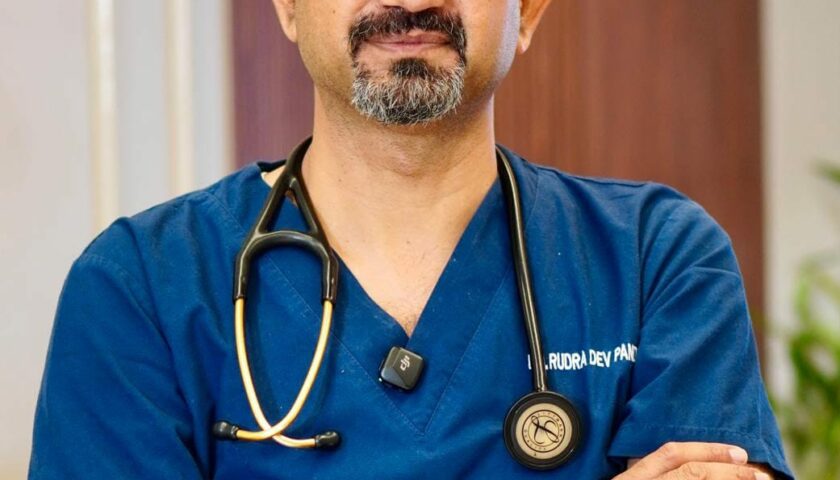
Dr. Rudradev Pandey, Director – Interventional Cardiology, Suvira Multi Speciality Hospital, and his team performed intravascular ultrasound (IVUS)-guided percutaneous coronary intervention (PCI). IVUS provides detailed images from inside the coronary artery, allowing physicians to accurately assess the extent of calcium, vessel dimensions and the characteristics of the blockage. It also helps in selecting the appropriate stent size and subsequently assessing whether the stent has expanded adequately.
To modify the severely calcified lesion, the team performed rotational atherectomy, using a 1.5-mm rotaburr. The technique uses a specialised rotating burr to carefully modify and prepare heavily calcified plaque, allowing subsequent balloon expansion and stent delivery in lesions that may otherwise be extremely difficult to treat.
Following successful lesion preparation, drug-eluting stents were deployed across the diseased segments. IVUS was then used again to evaluate the final result and optimise stent expansion and apposition. The procedure achieved an excellent final angiographic as well as intravascular result.
“Treating severely calcified coronary lesions in an elderly high-risk patient requires meticulous planning, appropriate lesion modification and precise imaging guidance. IVUS and rotational atherectomy can be extremely valuable in selected complex cases,” said Dr. Rudradev Pandey.
According to the treating team, severe coronary calcification is one of the major challenges in complex coronary interventions, particularly among elderly patients. When calcium is extensive, conventional balloon angioplasty may not adequately open the lesion, while inadequate stent expansion can potentially compromise the long-term outcome. Advanced calcium-modification techniques and intravascular imaging can therefore play an important role in carefully selected patients.
The successful treatment highlights the expanding role of advanced intravascular imaging and calcium-modification technologies in managing complex coronary artery disease, particularly in elderly and high-risk patients who may have challenging vascular anatomy or may not be ideal candidates for conventional surgical approaches.
Suvira Multi Speciality Hospital, Jaipur, is developing advanced capabilities in complex coronary interventions, including IVUS, rotational atherectomy, intravascular lithotripsy and other contemporary interventional cardiology techniques, enabling the management of increasingly complex coronary cases through minimally invasive procedures.