
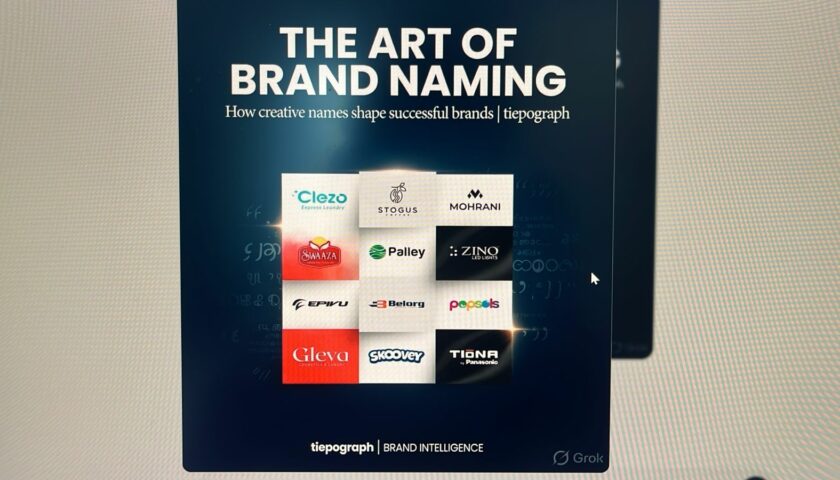
Only in India do an upscale restaurant serving exquisite meals and a hole-in-the-wall eatery serving heart-stopping meals (quite literally!) have one thing in common. Their generic names. Here, “Royal” is a fine-dining specialty restaurant as well as a street joint for late-night diners. That’s the problem hiding in plain sight–a brand naming crisis.
Different Brands, Same Names
Every supermarket sounds similar. It’s either “Fresh”, “Natural” or “Green”, and so does every bottled-water brand that refuses to be known as anything more than “Aqua” and “Pure”. The sheer overuse of generic adjectives defining brands for several decades now has led to both the brand owners as well as their consumers being completely numb to the names. That’s from a psychological perspective. From the logistical perspective, this deluge of common, undistinguishable names is causing rampant trademark rejections.
Over 800 D2C brands are vying for the fickle attention of India’s 750 million internet users. To survive such stiff competition, a name can be the differentiator between easy recall value and exorbitant marketing spend.
The Agency Set to Solve Sameness
Tiepograph, a naming agency, is set to unravel a pattern that most founders have stopped noticing: India’s brands are beginning to sound interchangeable. It wasn’t a single eureka moment for Hitesh Talreja, Founder of Tiepograph. “It was a pattern I observed everywhere,” he explains.
“The pattern of successful brand names standing out while still being accessible to every person who interacts with it.” Like all things good and lasting, simplicity–Hitesh observed–was central to a good brand name. “A good name, he adds, survives regional accents, hurried conversations, and imperfect spelling.”
“Think Wasshential, for instance. This former name of an express laundry service stuck to the “wash”, “clean”, and “essential” word range. In doing so, the long name became a hindrance for everyone–the consumers, franchise owners and even staff owners.”
Tiepograph renamed it as Clezo, a short and modern name that was easy to pronounce across accents. “In our pursuit of scaling our business, we had overlooked our name. To our surprise, a simple name change eased our scalability in ways we hadn’t projected,” explains Nilesh Bhoir, Founder Clezo.
The Science behind Naming
No, it’s neither instinct nor AI. Tiepograph’s consistent delivery of lasting brand names is owing to their scientific naming system, at the core of which is a proprietary library of over 7,500 morphemes. Morphemes are the atoms of words. They are the smallest unit of a word that cannot be broken down further. Rather than existing dictionary words, Tiepograph engineers names from these raw linguistic building blocks, controlling tone, emotion, and recall at the level of the syllable itself.
The brand’s phonetic personality then leads the approach of naming. “Modern and soft or energetic and youthful, the brand’s personality, target audience, and geography dictate the route we take to name the brand.” Sound symbolism plays a vital role here too. “The sound of a name—the way it sits in the mouth of a distributor in Bihar or a customer in Kerala—that is what determines whether a brand travels or stays stuck,” Hitesh elaborates.
Overall, in the construction of the best brand name, morphemes are the raw material, sound symbolism the tool, and widespread testing the engineering.
Tiepograph’s Way of Naming
“Our job does not end at just coming up with the right name. That’s only phase one. We run pan-India sound testing to check how the sound is pronounced and perceived across India. Followed by cultural and cross-linguistic screening to eliminate names that carry unintended meanings, awkward associations, or pronunciation risks in specific regions.”
Lastly, comes trademark risk screening. Among the most vital of all the tests, this screening reduces legal risk before brand owners make the name billboard official.
From research to registration, Tiepograph’s process takes approximately ten working days. Ten days later, founders receive a shortlist of original names, each having undergone tests that check trademark availability, regional pronunciation and consumer recall.
A Portfolio that Puts Entrepreneurs First
Over the course of 7 years, Tiepograph has named and renamed more than 400 brands. That’s 400 varied personalities. 400 founders trying to make memorable brands in a market flooded with sameness. That’s 400 names that carry the mission and vision of enterprises. That’s 400 stories condensed yet alive in 400 names.
Clients including Panasonic, and a growing roster of Indian startups across fashion, food, fintech, and manufacturing, have come through that process.
And Here’s Why they Keep Coming Back
Today, a 70-year-old woman in Gujarat can sell her brand of home-made pickles to a family in Karnataka with delightful ease. Yes, that is a testament to blurring boundaries and growing opportunities. Yet, this also means that the name of your brand matters now more than ever.
Deciding your brand naming with instinct is a risk no founder should take. “Every name we get right becomes proof that naming is not an afterthought”, says Hitesh. “It is the first business decision. And in India right now, it is a woefully underestimated one”.