Today, power rarely reveals itself through military force or formal agreements. Instead, it operates quietly through debt, investments, trade terms, technology dependencies, and access to financial systems. As the world enters a period of heightened geopolitical competition, the boundary between economics and national security is increasingly difficult to draw. The IMF calls this shift “geoeconomics,” and the World Economic Forum identifies geoeconomic confrontation as a key risk to the global economy.
Anirban Ray’s The Encirclement, published by Nu Voice Press, enters the evolving landscape.
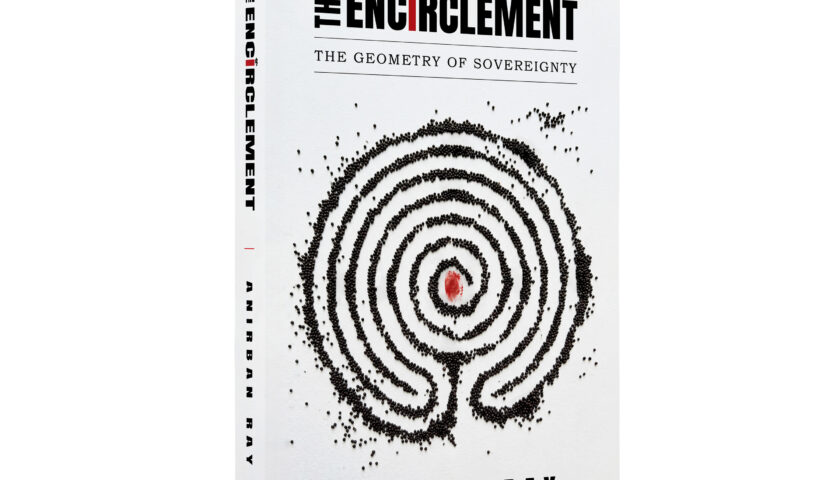
The novel brings geopolitics into sharp personal focus, beginning with seven-year-old Nandana arranging mustard seeds into a spiral on the kitchen floor, recreating the chakravyuh from the Mahabharata. Thirty years later, the same pattern surrounds her as she signs away a nation’s sovereignty under a borrowed name. RAW officer Vikram Malhotra sees it and refuses to let seeing be enough.
This image illustrates the intersection of global finance and personal identity, making the abstract tangible before statistics.
The novel’s urgency reflects current realities. Governments face record debt, trade fragmentation, sanctions, supply-chain disruptions, and strategic competition for technology and resources. The World Bank warns that high government debt strains emerging economies, while UNCTAD tracks mounting pressures from debt, trade uncertainty, and weakening cooperation. Against this backdrop, Ray’s fiction raises a timely question: when does economic dependence become political leverage, and where does the line between development and coercion lie?
The Encirclement stands out for its avoidance of didacticism. Ray spent nearly thirty years in technology consulting, including over two decades at IBM, advising Fortune 500 CXOs on enterprise strategy and transformation, cloud computing, and AI. He describes his experience as being in “the rooms where policy becomes a spreadsheet.” Inspired by John Perkins’s Confessions of an Economic Hit Man, which he calls “the architecture,” Ray follows that architecture into the human lives it moves through. Amidst it, Charulata Roy, Nandana’s mother, offers a counterweight: her philosophical essays and letters, in Ray’s words, serve as “a heart hidden inside the machine’s geometry.”
Ray develops plot and ideas in parallel. Questions of sovereignty are explored alongside belonging, and economic ambition intersects with family inheritance. Global power is viewed through the lens of memory, language, and the significance of a borrowed name. This structure gives the novel broad appeal: readers of political thrillers will find a compelling discussion of coercive economics, while readers of literary fiction will encounter an exploration of moral compromise and diasporic identity.
Ray’s decision to leave a stable, decades-long career in global institutions to write full-time reflects the novel’s central theme: sometimes stepping away from power is necessary to understand it. The Encirclement not only asks who holds power but also examines its impact on those who participate in, benefit from, question, and ultimately live with its consequences.
As economic security, sovereignty, and geopolitical competition become increasingly intertwined, The Encirclement poses two enduring questions: How much dependence is too much? When does participation in a system become a choice to sustain it?