
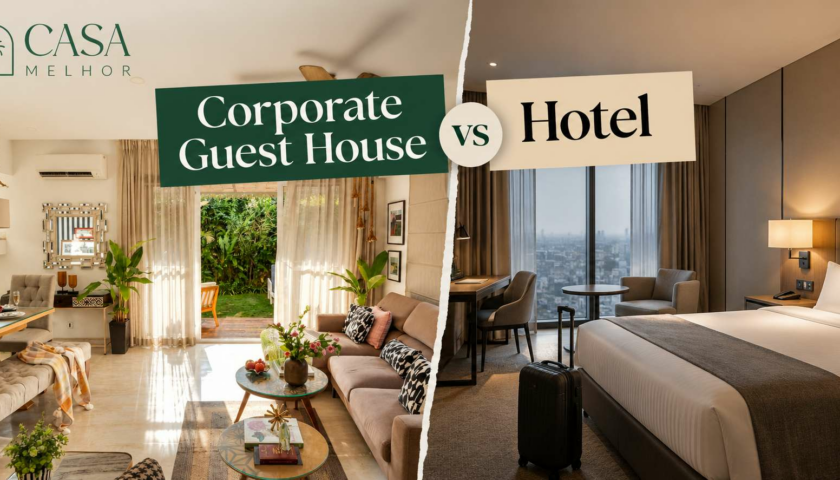
As companies manage more project travel, employee relocations, training programmes and extended assignments, corporate guest houses are gaining relevance as a flexible alternative to conventional hotel stays.
Business travel is evolving beyond short hotel visits. Employees today travel for projects, audits, training, leadership meetings, relocation and assignments that can extend from several days to several months.
This shift is prompting organisations to reconsider how they manage employee stays. A professionally managed corporate guest house can provide employees with more space, privacy and everyday facilities while giving businesses a more structured approach to accommodation.
Longer Business Assignments Need More Than a Hotel Room
A two-day business trip and a two-month project assignment create very different accommodation requirements.
For longer stays, employees may need furnished bedrooms, living spaces, kitchens, Wi-Fi, housekeeping and laundry facilities. Having access to these everyday conveniences can make it easier for professionals to maintain their routines while working away from home.
This makes a company guest house particularly relevant for consultants, engineers, project managers, employees undergoing training and professionals temporarily relocating to another city.
Companies Are Rethinking Repeated Hotel Bookings
For organisations with frequent employee travel, accommodation is not simply a room expense. Every trip can involve reservations, invoices, extensions, cancellations, employee coordination and vendor management.
Instead of repeatedly arranging individual hotel stays, companies can use managed residences for recurring visits, longer assignments and project teams.
Well-planned company accommodation can help businesses create a more consistent stay experience while potentially simplifying accommodation management for internal travel and administrative teams.
Team Travel Creates Another Use Case
Corporate guest houses are also becoming relevant when multiple employees need to travel together.
Rather than placing employees in separate hotel rooms, a larger managed residence can combine private bedrooms with shared living areas. Teams can stay together while still maintaining individual privacy.
This format can also work for a team offsite, project kick-off, leadership workshop or training programme where employees benefit from common spaces and opportunities to interact outside formal sessions.
Employee Relocation Is Driving Longer Stay Requirements
Employee relocation presents another accommodation challenge.
Professionals moving to a new city may need several weeks to identify permanent housing, complete documentation and relocate their families. Temporary corporate accommodation can provide a stable base during this transition.
Instead of immediately committing to permanent housing, employees have time to settle into their new role and understand the city before making longer-term decisions.
Business Travellers Increasingly Need a Complete Living Environment
The longer an employee stays away from home, the more important everyday facilities become.
Reliable Wi-Fi, privacy, comfortable workspaces, housekeeping, kitchens, laundry facilities and convenient locations can have a significant impact on the experience of an extended assignment.
A professionally managed business stay can therefore go beyond providing a room for the night, offering an environment where employees can comfortably live and work during longer assignments.
Corporate Accommodation Becomes Part of Business Travel Planning
Hotels continue to serve an important purpose, particularly for short business trips. Corporate guest houses address a different set of requirements, including recurring employee travel, extended projects, relocations and team movement.
Companies evaluating corporate accommodation should consider location, security, transport connectivity, Wi-Fi, housekeeping, workspace, kitchen and laundry facilities, cancellation policies and on-ground support.
As business travel becomes more varied, accommodation is increasingly becoming part of broader workforce and travel planning. For organisations managing frequent or extended employee movement, corporate guest houses are emerging as a practical model that combines the comfort of a residence with the services and operational structure required for business travel.