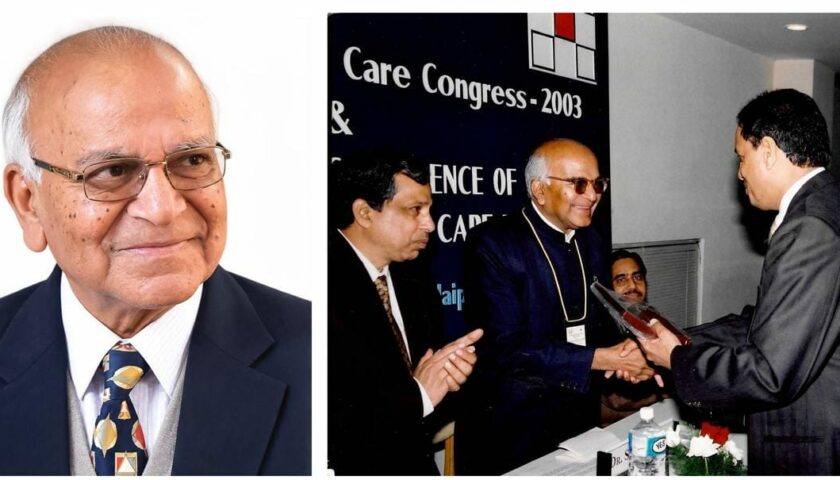
Dr Swayambar Prasad Sudrania (90), a paediatrician, once received a phone call from Nepal at around 2 am. A caller said his baby had been crying continuously for two hours and asked for medicine. Dr Sudrania asked to hear the baby’s cry and, after listening for a few minutes, prescribed medicine. The next day, the caller thanked him, saying the baby had stopped crying. Dr Sudrania had identified ear pain.
The first MD in Paediatrics and a gold medallist in the history of the University of Rajasthan, Dr Sudrania began his professional journey at JK Lone Hospital, Jaipur, in 1966, when medical technology was far less advanced. His curiosity about infant cries led him to develop a technique called the electrocrygram, which analysed a baby’s cry graphically to help identify possible illnesses. JK Lone Hospital was among India’s top 10 children’s hospitals.
“I was the first to identify clues to a baby’s illness from the sound of its cry,” he said. He recorded cries on a small tape recorder and visited the Central Electronics Engineering Research Institute (CEERI) in Pilani or Delhi University’s Physics Department to prepare graphs and study them. He presented the technique in Tokyo in 1982 as Electro Cry Gram as a Diagnostic and Prognostic Tool in Different Diseases in Paediatric Practice – A New Concept.
Drawing on C. V. Raman’s theories of sound, he converted cries into electrical signals represented graphically. A shrill cry, he explained, could indicate congenital vocal-cord abnormalities, while a hoarse cry could be associated with congenital heart disease or hypothyroidism. Cry variations could also offer clues to neurological, respiratory and other systemic disorders. Asked whether anyone else practised electrocrygram, he replied, “I developed this technique, and it will be gone with me.”
Another contribution was his early work on oral rehydration. He researched electrolyte disturbances in infantile diarrhoea, then a major cause of childhood mortality. His postgraduate thesis, A Study on Serum Electrolytes in Infantile and Early Childhood Diarrhoea, examined sodium and potassium imbalances.
“I sent my thesis to the WHO around 1967–68 and also served as a member of the WHO Committee on ORS in Geneva,” he recalled. He described Rajasthan’s neembu ki shikanji, made with lemon juice, sugar, salt and water, as a way to replenish fluids and salts, while emphasising that ORS contains carefully measured proportions of salts and glucose. He also said he was a key contributor to developing oral rehydration powder, named Oral Rehydration Solution (ORS) by the World Health Organisation (WHO).
During the late 1960s and 1970s, Dr Sudrania also explored medical dermatoglyphics—the scientific study of fingerprint and palmar ridge patterns—as an aid to screening congenital, genetic, neurological and developmental disorders. Initially attracted by palmistry, he later explored the subject clinically.
From 1976 to 1980, he taught at medical colleges in Tripoli and Benghazi, Libya. He said cry analysis and dermatoglyphics helped him overcome language barriers when communicating with people who spoke Arabic.
Even today, he consults patients at home and receives calls from the United States, the United Kingdom and elsewhere. At times, he still assesses a child’s condition by listening to the sound of the child’s cry.