
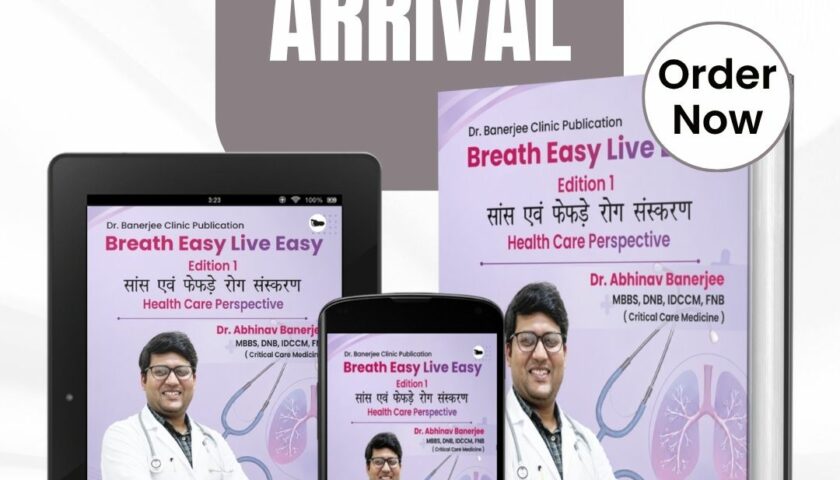
In a time when air pollution, changing lifestyles and respiratory illnesses have become increasingly visible concerns, Dr Abhinav Banerjee’s Breath Easy, Live Easy – Part 1 arrives as a timely attempt to make conversations around lung health more accessible to the general reader. The book brings together information on common respiratory conditions and everyday habits that can influence breathing and overall well-being. Published by Bigfoot Publications in July 2026, the book is designed as an accessible health-awareness resource rather than a conventional medical textbook.
The book opens with subjects that many readers encounter in everyday life, particularly allergies and asthma. It explains common triggers, symptoms, possible complications, methods of diagnosis and approaches to prevention. The discussion is presented in a question-and-answer-like, practical manner, making complex medical terminology easier to approach. The sections on children and respiratory health are especially relevant for families, while the discussion of environmental triggers connects individual health with larger concerns such as pollution and changing weather patterns.
One of the book’s notable strengths is its emphasis on prevention. Rather than presenting respiratory illness solely through the lens of medication and clinical treatment, Dr Abhinav Banerjee repeatedly draws attention to lifestyle, environmental awareness and timely medical consultation. The section on pulmonary diseases discusses symptoms, investigations such as chest X-rays, HRCT scans, pulmonary function tests and bronchoscopy, followed by an overview of treatment options. The book also touches upon machine-assisted respiratory care and lifestyle management.
The author extends this preventive approach to lung health more broadly. A dedicated section offers practical suggestions for maintaining healthy lungs, including avoiding smoking and pollution, wearing masks when appropriate, maintaining cleanliness, exercising and incorporating breathing practices into daily life. Such advice gives the book a distinctly public-health-oriented character.
Another important theme is tobacco use. The chapter on tobacco examines its impact on the lungs and discusses conditions including lung cancer, COPD and asthma. Its message is direct: tobacco cessation is not merely a lifestyle choice but an important step towards protecting respiratory health. The chapter’s concluding appeal to give the lungs and life greater freedom captures the accessible and awareness-driven tone of the book.
The book also moves beyond the lungs in the narrow sense to examine the relationship between breathing and sleep. Its section on sleep medicine discusses insomnia, snoring and sleep-related breathing problems, while introducing readers to sleep studies and treatments such as CPAP and BiPAP. This broadens the book’s scope and reminds readers that respiratory health can intersect with sleep, energy, concentration and quality of life.
A particularly contemporary section looks at the growing role of artificial intelligence in pulmonology and critical care. Dr Abhinav Banerjee discusses how AI-assisted analysis may contribute to diagnosis, monitoring and personalised treatment, while also acknowledging the importance of data quality, trained professionals and human judgement. The book appropriately presents technology as a supporting tool rather than a replacement for doctors.
Visually, the book adopts an instructional format, using headings, illustrations, highlighted sections and bilingual medical terminology to make the material easier to navigate. Its presentation is clearly aimed at readers who may not have a medical background.
Ultimately, Breath Easy, Live Easy – Part 1 is best read as a public-health and respiratory-awareness guide. Its central message is simple but significant: breathing is something we often take for granted until illness makes us conscious of it. By bringing together information on allergies, asthma, lung diseases, pollution, tobacco, sleep disorders, prevention and emerging medical technologies, Dr Abhinav Banerjee encourages readers to pay greater attention to an aspect of health that is fundamental to everyday life.
For readers interested in understanding respiratory health in straightforward language, the book offers a useful starting point, and, more importantly, encourages a culture of awareness, prevention and timely medical care.