
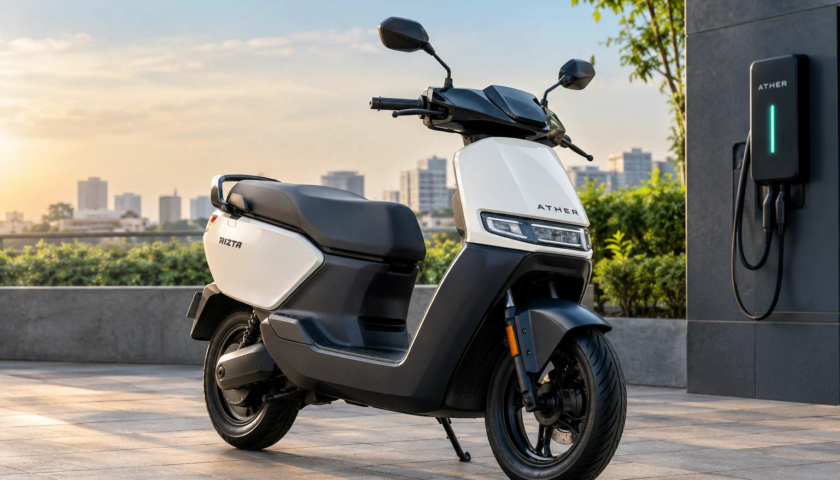
The Ather Rizta is designed as a practical family electric scooter, with easy city use, useful storage, comfortable seating and two battery choices.
That means the buying decision should go beyond the highest range figure. Charging access, daily distance and the equipment you actually use matter just as much as the headline IDC range.
Which Ather Rizta battery and range suit your routine?
The current Rizta S and Rizta Z can be configured with 2.9 kWh and 3.7 kWh battery options. Ather’s live configurator currently lists 123 km and 161 km IDC range choices, while an older official specification sheet lists 159 km for the 3.7 kWh pack. For a current purchase, the live 161 km figure is the more relevant reference, but actual road range will still vary with riding style, load, speed, gradients and temperature.
The bigger battery is most useful for longer daily distances or less frequent charging. For a short commute with easy home charging, the smaller pack may already provide enough buffer.
Because both batteries deliver the same peak power and torque, paying more for the larger pack does not buy stronger acceleration. It mainly buys additional range and fewer charging stops.
Ather Rizta also offers longer battery-warranty options through its software and warranty packages. The standard battery warranty remains 3 years or 30,000 km, while longer cover may be available depending on the selected package.
Does the Ather Rizta work well as a family scooter?
This is the area where the Rizta has a particularly clear identity.
It offers 34 litres of under-seat storage, and an optional 22-litre frunk can take total storage to 56 litres. That is useful for shopping bags, work items, a helmet or the smaller objects that family scooters tend to carry every day.
The long seat and broad floorboard support two-up use. Practical features such as Reverse Mode and AutoHold also help with tight parking and inclines.
Which Rizta variant makes more sense?
The choice between Rizta S and Rizta Z is mainly about equipment rather than basic performance.
Both offer the same 4.3 kW peak power, 22 Nm torque, 80 km/h top speed and 4.7-second 0-40 km/h time. Rizta S uses a 7-inch DeepView display, while Rizta Z adds a TFT touchscreen, Google Maps navigation, Magic Twist and a more feature-rich connected experience.
The S covers the essentials, while the Z makes more sense if integrated navigation, a TFT interface and added convenience features matter to you.
How much can the Rizta save per kilometre?
A useful EV comparison should look at energy cost per kilometre rather than simply saying electricity is cheaper than petrol.
Ather currently uses an illustrative comparison based on a petrol scooter returning 40 kmpl with petrol at Rs. 110 per litre. On those assumptions, petrol costs about Rs. 2.75 per km.
For the Rizta, Ather uses an assumption of 35 km per unit of electricity and an electricity tariff of Rs. 10 per unit. That works out to about Rs. 0.29 per km in electricity cost.
That creates an indicative energy-cost difference of roughly Rs. 2.46 per km.
At 1,000 km of monthly riding, the difference would be about Rs. 2,460 in energy cost before other ownership expenses are considered.
This is not the same as total ownership savings. Insurance, tyres, servicing, financing, charging equipment and purchase price still matter. Higher-mileage riders have more opportunity to recover the EV premium through lower energy cost.
What should you check before switching from a petrol scooter?
Charging access should be confirmed before you commit.
If the scooter can be charged easily where it is normally parked, the ownership routine can be very convenient. If you depend entirely on public charging, the experience may be less predictable even with the larger battery.
Public fast charging adds flexibility, but home charging will still shape daily convenience. Also test the scooter with your regular pillion and check space and low-speed balance when loaded.
How can you purchase an Ather Rizta without paying the full amount upfront?
Once the battery, variant and charging setup already make sense for your routine, you can decide how to fund the purchase.
A Two Wheeler Loan can spread the on-road cost across monthly instalments instead of requiring the entire amount at once. Subject to eligibility and applicable terms, loan amounts can range from Rs. 35,000 to Rs. 21 lakh, repayment tenures can run from 6 to 84 months, and financing may cover up to 100%* of the two-wheeler’s on-road price.
Choose the tenure by considering total repayment, not only the lowest monthly instalment. A longer tenure can make each payment easier but may increase overall interest.
With Navaratri and Diwali around the corner, Bajaj Mall is currently listing festive Ather Rizta offers across 2.9 kWh and 3.7 kWh versions. Compare the available deal on the exact battery and variant you already intend to buy, and use any worthwhile benefit to reduce the purchase burden rather than as a reason to upgrade unnecessarily.
Can Ather Rizta be the right electric scooter for you?
The Ather Rizta makes the strongest case for buyers who want an electric scooter to work as a practical family vehicle. The 2.9 kWh version suits shorter predictable commutes with easy charging, while the 3.7 kWh version provides a larger range buffer. Because both deliver the same 4.3 kW power and 22 Nm torque, choose the larger battery for distance, not performance.
If charging is convenient and your annual running is high enough for lower energy cost to matter, the Rizta can replace a petrol family scooter without giving up everyday usefulness.
*Terms and conditions apply