
Executive Summary
The Union Ministry of Environment, Forest and Climate Change has notified the Solid Waste Management Rules, 2026, replacing the 2016 framework and taking effect from April 1, 2026, with mandatory four-stream waste segregation across every generator of waste in India. Entities that cross defined thresholds, 20,000+ square metres of floor space, 40,000+ litres of daily water use, or 100+ kg of daily waste, now fall under an Extended Bulk Waste Generator Responsibility clause requiring them to process wet waste on-site or obtain third-party certification. Klimrus, which manufactures the Sunvik line of solar-powered composting machines across a 10 kg/day to 1000 kg/day capacity range, says the rule effectively moves organic waste processing from a sustainability initiative to a compliance obligation for large facilities.
What the Solid Waste Management Rules, 2026 Actually Change
The 2026 Rules, notified under the Environment (Protection) Act, 1986, replace the Solid Waste Management Rules of 2016 and take effect on April 1, 2026. The core structural change is a shift from voluntary segregation guidance to enforceable, source-level obligations for both households and institutions.
–Four-stream segregation becomes mandatory: wet waste (kitchen and food scraps) for composting or bio-methanation, dry waste (plastic, paper, metal) for Material Recovery Facilities, sanitary waste (diapers, sanitary products) for secure storage, and special care waste (paint, bulbs, medicines) for authorized collection.
–Extended Bulk Waste Generator Responsibility (EBGR): large facilities must ensure environmentally sound processing of their own waste rather than relying solely on municipal collection.
–Digital tracking: a centralized online portal will track waste from generation through disposal, replacing physical reporting to urban local bodies.
–Polluter Pays enforcement: pollution control boards can levy environmental compensation on non-compliant generators.
–Refuse Derived Fuel (RDF) mandate: a phased substitution requirement of 5% to 15% over six years for eligible dry waste streams.
–Landfill restriction: landfills are to be limited to non-recyclable and inert material only, tightening the pathway for unsegregated waste.
Who Qualifies as a Bulk Waste Generator
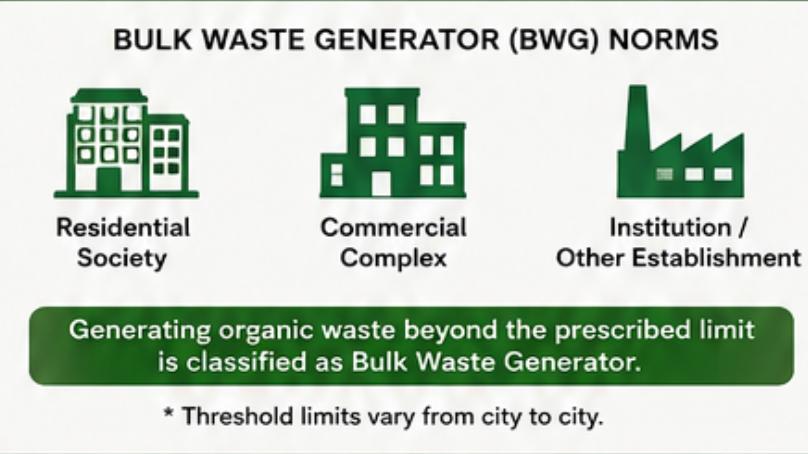
Under the Rules, an entity is classified as a Bulk Waste Generator, and therefore subject to EBGR, if it meets any one of these thresholds:
–20,000 square metres or more of built-up floor space
–40,000 litres or more of daily water consumption
–100 kg or more of daily waste generation
This threshold structure captures a wide institutional base directly: residential societies and townships, hotels and hospitality campuses, shopping malls, office parks, hospitals, educational institutions, and manufacturing facilities.
Why On-Site Wet Waste Processing Is the Compliance Center of Gravity
Of the four waste streams defined in the Rules, wet waste is the one that carries a direct processing mandate at the point of generation. Dry, sanitary, and special care waste are routed to external facilities, but wet waste under EBGR must either be processed on-site through composting or bio-methanation, or the generator must obtain third-party certification confirming compliant processing elsewhere. For a bulk generator, that means the choice is narrowed to two paths: install processing capacity, or contract it out and document it.
For facility operators already managing food waste from kitchens, cafeterias, or landscaping, on-site composting converts a compliance cost into a recurring operational function, producing usable compost while avoiding the transport and certification overhead of the second path.
Inside the Compliance Option: On-Site Composting Equipment
Klimrus’s Sunvik composting machine range is built around this exact use case: institutional and commercial food waste, processed where it is generated.
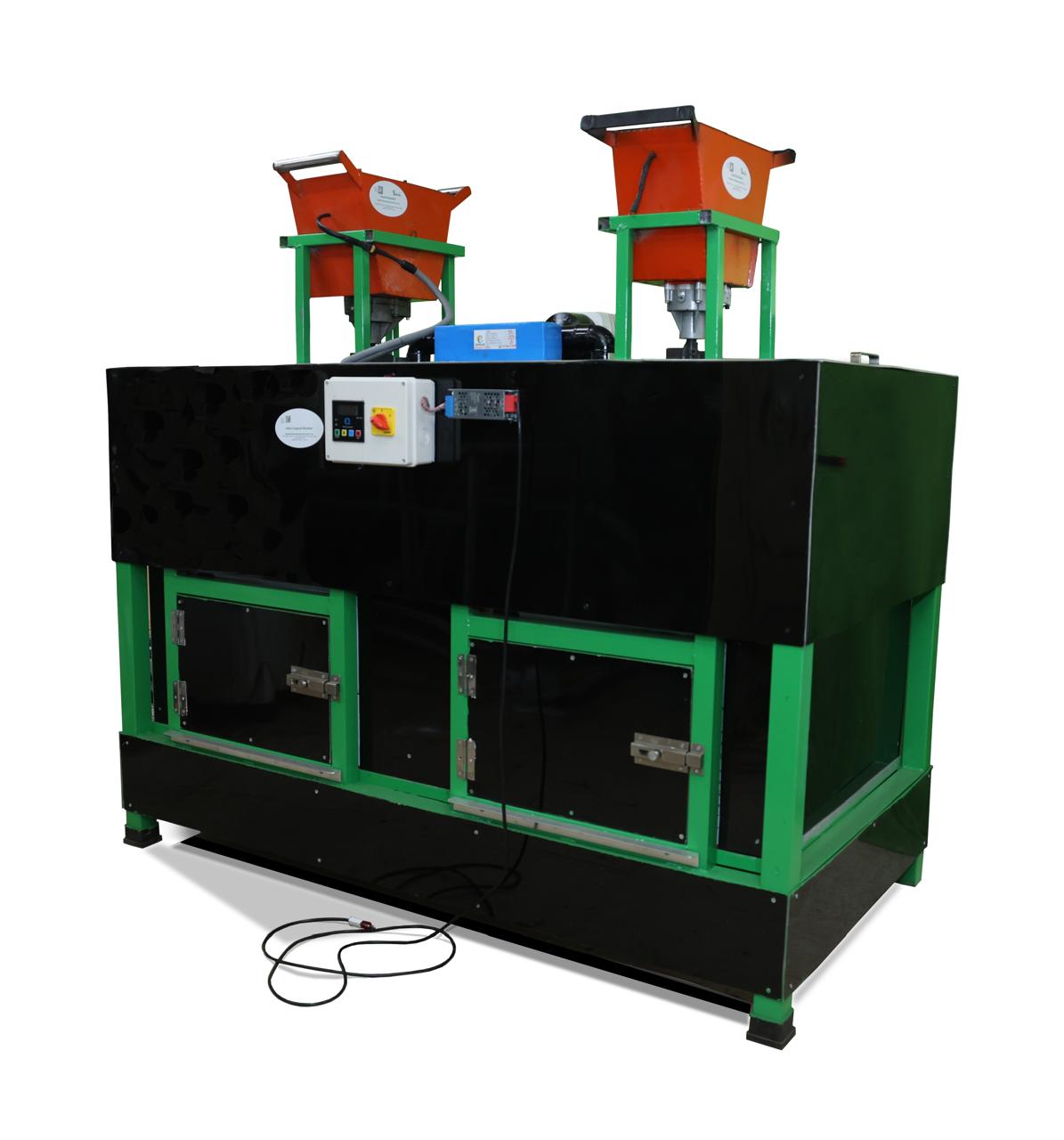
The Sunvik Range
Model | Capacity | Typical Fit |
Sunvik 10 kg/day | 10 kg/day | Small offices, cafes |
Sunvik 25 kg/day | 25 kg/day | Mid-size apartments, small hotels |
Sunvik 50 kg/day | 50 kg/day | Schools, mid-size offices |
Sunvik 100 kg/day | 100 kg/day | Hospitals, larger residential complexes |
Sunvik 200-250 kg/day | 200-250 kg/day | Malls, large hotels |
Sunvik 500-1000 kg/day | 500-1000 kg/day | Municipal corporations, large industrial campuses |
Source: Klimrus product listings, 2026
Klimrus describes the Sunvik line as India’s first solar-powered composting machine series, positioned around ISO-aligned processing and full conversion of organic waste into usable compost, rather than partial digestion or landfill-bound residue.
Matching Capacity to the New Thresholds
–A facility generating close to the 100 kg/day EBGR threshold is a direct fit for the mid-capacity Sunvik models (50-100 kg/day), sized to process daily output without excess idle capacity.
–Large campuses (malls, hospital networks, township-scale residential developments) generating several hundred kilograms of wet waste daily map to the 200 kg/day and above range.
–Facilities below the mandatory threshold today but growing toward it can still adopt smaller units proactively, avoiding a compressed procurement timeline closer to enforcement dates.
SWM Rules 2016 vs. 2026: What Changed
Attribute | SWM Rules, 2016 | SWM Rules, 2026 |
Segregation streams | Wet and dry (two-stream) | Wet, dry, sanitary, special care (four-stream) |
Bulk generator obligation | General processing encouragement | Extended Bulk Waste Generator Responsibility with defined thresholds |
Tracking | Manual/physical reporting | Centralized digital portal |
RDF requirement | Not mandated | 5%-15% phased substitution over six years |
Enforcement | Limited compensation framework | Polluter Pays with pollution control board levies |
Effective date | 2016 | April 1, 2026 |
Source: PIB press release, Ministry of Environment, Forest and Climate Change, January 2026
Industry Perspective
“Composting equipment used to be a sustainability line item that facility managers could defer,” said Klimrus’s composting engineers. “The EBGR clause changes that calculation. Once your floor space or daily waste crosses the threshold, on-site wet waste processing stops being optional and becomes something an auditor can ask to see.”
On sizing decisions, Klimrus’s composting engineers added: “The mistake we see most often is facilities buying capacity for their current waste volume rather than their EBGR classification. If you’re within reach of the 100 kg/day threshold, you should be sizing for it now, not after the compliance deadline.”
What Facility Managers Should Do Before April 2026
- Audit current daily waste generation against the three EBGR thresholds to confirm classification.
- Decide between on-site processing and third-party certification based on space availability and existing kitchen or landscaping waste volumes.
- Size equipment to the EBGR threshold, not just current output, to avoid a second procurement cycle.
- Prepare for the digital tracking portal by establishing internal waste-logging processes ahead of the mandated switch from physical reporting.
Conclusion
The Solid Waste Management Rules, 2026 convert wet waste processing from a discretionary sustainability measure into an enforceable obligation for bulk generators, effective April 1, 2026. For facilities crossing the floor space, water use, or daily waste thresholds, on-site composting capacity, sized correctly and installed ahead of the deadline, is the most direct route to compliance under the Extended Bulk Waste Generator Responsibility clause.