
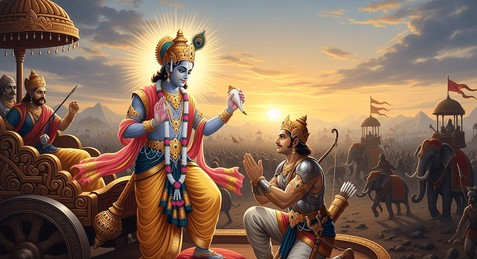
When extraordinary power is not accompanied by consciousness, who takes responsibility for its consequences?
Some stories from India’s civilisational memory acquire new meaning as the world changes. The story of Barbarik is one such narrative.
The story is preserved in the Skanda Purana, particularly the Kaumarika-khanda of the Maheshvara-khanda, and later became central to regional and devotional traditions associated with Khatu Shyam.
That distinction does not diminish its philosophical relevance. Instead, it offers a fascinating metaphor for one of the defining questions of the AI age.
What happens when power becomes greater than the consciousness governing it?
Barbarik’s Arrows represent Extraordinary Power, Limited Judgment
According to the Skanda Purana tradition, Barbarik was the son of Ghatotkacha and a warrior of exceptional ability. Popular retellings associate him with 3 arrows capable of identifying targets and executing their task with remarkable precision. And the 3 arrows represent Creation, Preservation and Destruction. The 3rd arrow was meant to eliminate all those who were identified for elimination.
But the deeper question is not how powerful the arrows were.
It is what happens when a tool possesses Extraordinary Capability but no Independent Moral Judgment.
Barbarik had also promised his mother : I shall always protect the one who is the weaker, the losing side. Lord Krishna understood, with Barbarik participating in the war, the war would swing like a pendulum from winner-to-loser and from loser-to-winner until it had wiped out both the sides, leaving Barbarik alone to survive.
This reflects a broader principle:
A capability designed to solve a problem can itself become a larger problem when its consequences are not understood.
Humanity has encountered this repeatedly. Nuclear technology created deterrence while introducing existential risk. Industrialisation created abundance while contributing to environmental damage. Digital networks connected the world while enabling Surveillance, Manipulation and Misinformation.
The central question remains:
Who controls the power, and who is accountable for its consequences?
Krishna’s Test : Just before the war, Krishna, dressed as an ordinary Brahmin, and asked Barbarik – so many warriors around, how do you think you can win the war with only 3 arrows!
Barbarik’s Ego was Challenged, he replied: My arrows are enough to bring this war to an end!
Krishna quipped – Can you prove it? Can your arrow penetrate all the leaves of that peepal tree?
Challenged by an Ordinary Brahmin, Barbarik pulled out his arrow and fired at the peepal tree. The arrow started penetrating the peepal leaves, one by one, each one. The arrow completed its task, Meticulously and Systematically, with Acute Perfection. Seeing the meticulousness of the arrow, Krishna hid one peepal leaf under his feet. The arrow, started hovering around Krishna’s feet. Barbarik understood the situation and requested Krishna to remove his feet, else the arrow would tear into his feet!
This episode belongs to later popular retellings and should not be confused with the exact Skanda Purana account.
Yet as a metaphor, it is powerful.
The arrow does exactly what it is designed to do. It does not hesitate or question the instruction. It executes.
And that raises an important distinction:
Perfect execution is not necessarily perfect judgment.
The Arrow and Artificial Intelligence :
This is where the Barbarik story begins to resonate with artificial intelligence.
AI can process vast quantities of information, identify patterns, generate content, optimise processes, predict outcomes and execute tasks at a scale beyond human capability.
Its speed and precision can be extraordinary.
But capability does not automatically create Moral Responsibility.
AI can optimise an objective, make recommendations and follow instructions.
The deeper questions remain :
What is the Objective? Who Decides the Objective? Who benefits? Who Decides Who Decides? Who could be harmed? Who is accountable when the outcome becomes unacceptable?
The arrow can execute.
But who defines the target?
Power Without Conscience : The deepest lesson of Barbarik may therefore not be about the weapon, but about the person controlling it.
AI is increasingly becoming an amplifier of human capability. It can amplify intelligence, productivity and creativity—but it can also amplify Bias, Misinformation, Surveillance, Manipulation, Institutional Power and Destruction.
The ethical question is therefore not simply: “What can AI do?”
It is: “What should AI be allowed to do? Who should be responsible when it does it?”
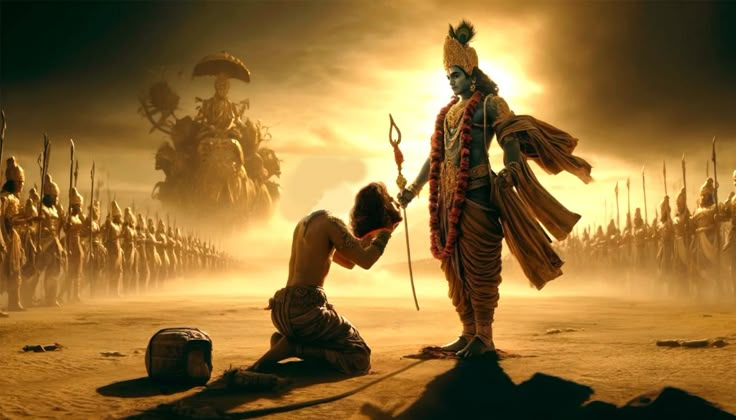
The Head and the Witness : Another profound element of the tradition is Krishna’s request for Barbarik’s head. The Skanda Purana connects Barbarik’s identity with Sūryavarcas and describes his destruction according to an earlier divine decree.
This is an interpretation, rather than a literal statement of the Skanda Purana, but its philosophical message remains striking: The head represents our Ego, our Thoughts, our Intelligence, our Plans, our Calculations, our Desires. It represents our I, the Ego. Lord Krishna had actually asked from Barbarik his Ego, his ‘I-ness’.
Power does not automatically produce Wisdom.
Intelligence does not automatically produce Compassion.
Information does not automatically produce Consciousness.
Technology does not automatically produce Responsibility.
The tradition further describes Barbarik’s head being made immortal and placed upon a peak, allowing him to witness the eighteen-day battle.
The warrior who possessed enormous power becomes the witness, rather than the executor.
In the era of AI, this offers an important lesson: humanity needs not only technologies capable of acting faster, but also systems and institutions capable of understanding consequences before they become irreversible.
Three Arrows in the AI Age are three questions for artificial intelligence:
1. What are we trying to identify?
AI can identify patterns, people, risks and behaviours. But identification without context can become profiling.
2. What are we trying to change?
AI can automate, optimise, rank, recommend and influence. But optimisation without ethics can create harmful outcomes.
3. Who is accountable for the consequence?
“The AI did it” cannot become the technological equivalent of “I was only following orders.”
Responsibility ultimately belongs to the people and institutions that design, deploy, govern and use these systems. Who Decides Who Decides?
The Final Arrow
The Barbarik story is not ultimately a warning against power.
It is a warning against Power without Wisdom.
AI can help discover medicines, improve education, advance scientific research, increase productivity and expand human creativity. But the same technology can magnify Prejudice, Manipulation, Greed and Irresponsibility.
The real choice is therefore not simply between accepting AI and rejecting it. It is between Availability of Power, and its Responsible Usage.
Barbarik’s arrows were extraordinary because they could execute their task with remarkable precision. But precision alone was not enough.
Power needed purpose.
Purpose needed judgment.
Judgment needed responsibility.
And responsibility needed consciousness.
Humanity is creating its own three arrows today:
Artificial Intelligence. Automation. Autonomous Decision-Making.
They can identify.
They can predict.
They can execute.
But before we release these arrows into the world, we must ask:
Are we creating only more powerful arrows—or are we developing the consciousness required to decide if those arrows should never be fired?
Technology gives extraordinary power. This is where the Greatest Tragedies of Humanity is hidden. If mankind is able to acquire Immense Power, and if that power is Devoid of any Consciousness, that power starts to consume Humanity. Power has no Conscience. When power comes without any Accountability or Responsibility, the power becomes fatal for humanity. It is easy to gather and develop Power through AI. Along with that Power also exists Legitimacy of Responsibility and Accountability.
Only responsibility can tell us how to use that power.
It is intriguing for the readers to contemplate that the person who was the most powerful warrior in Kurukeshetra was disallowed to participate in the war just before the beginning of the war!!
Perhaps the ultimate lesson of Barbarik is not that Krishna restricted the most powerful warrior, but that the greatest power is the ability to Restrain Oneself when one possesses the Ability to Destroy.
That is the Challenge before Artificial Intelligence.
And that is the Responsibility before Humanity.
About the Author
The author is a former Honda,Hyundai,Mahindra automotive quality specialist, currently works as a consultant with an IT organisation. He specialises in research-based studies and analysis in artificial intelligence and automotive industry.
Acknowledgements
The author acknowledges the Skanda Purana tradition and draws philosophical inspiration from works and ideas associated with Osho, Dr Rajiv Malhotra, Daniel Kahneman and Shoshana Zuboff. Interpretations connecting the Barbarik narrative with contemporary artificial intelligence are the author’s own.