
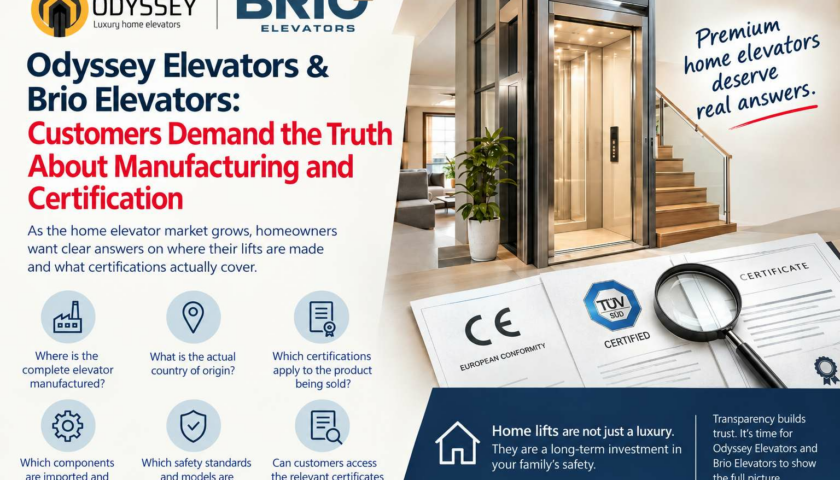
As the Home Elevator Market Grows, Buyers Want Clear Answers on Where Their Lifts Are Made and What Certifications Actually Cover
The Indian home elevators market is expanding rapidly, with homeowners increasingly investing in premium home lifts for villas, duplexes, independent houses and multi-level residences. But as brands such as Odyssey Elevators and Brio Elevators position themselves in the premium residential elevator segment, customers are asking a fundamental question: What exactly are they buying, where is it manufactured, and which certifications apply to the complete elevator?
For a homeowner spending several lakhs on a home elevator, manufacturing origin and certification are not minor details. They can directly influence a customer’s perception of quality, safety, technology and value.
Odyssey Elevators: Where Is the Complete Elevator Manufactured?
Odyssey’s website states that its elevators are imported from Europe and refers to CE certification, Machinery Directive 2006/42/EC compliance and EN 81-41 compliance.
That raises an important question for customers considering an Odyssey home lift:
Where exactly is the complete elevator manufactured?
Is the complete home elevator manufactured in Europe, or are components sourced from different countries and subsequently assembled or engineered for the Indian market?
Recent public reporting has raised questions about Odyssey’s manufacturing origin, including references to Turkish manufacturing and the distinction between imported components and a completely imported elevator.
There is nothing inherently wrong with sourcing components internationally. The issue is whether customers are being given a sufficiently clear distinction between European engineering, European components, imported components and the actual country of manufacture of the complete home elevator.
Brio Elevators: Which Product Does the Certification Actually Cover?
Similar questions are being raised about Brio Elevators.
Brio’s public website highlights TÜV-SÜD certification, CE-certified components and, for some products, “Made in India” claims. At the same time, individual Brio home lift pages describe particular models with different manufacturing and certification references, including a BE-300 page that states “100% Made in Italy.”
For consumers, these distinctions matter.
If one home elevator is made in India, another has Italian manufacturing references and another incorporates an overseas platform, customers should be able to clearly identify which product is manufactured where.
More importantly, when TÜV or CE is mentioned, customers should know exactly what that certification covers.
Is it certification of the complete home elevator?
Is it certification of a specific component?
Is it a type examination?
Does it relate to a particular model?
Or does it relate to a company’s management or manufacturing system?
These are very different things, and a homeowner should not have to determine the difference after signing a purchase agreement.
Customers Are Asking for Documents, Not Marketing Terminology
The issue is ultimately simple: show the documentation.
A customer considering Odyssey Elevators or Brio Elevators should be able to ask for:
- The legal name and address of the actual manufacturer
- The country where the complete home elevator is manufactured
- The manufacturing facility or factory details
- The countries of origin of major imported components
- The exact model covered by each certification
- The certificate number and issuing organisation
- The applicable safety standard
- The validity and scope of the certification
- Documentation establishing whether the certification applies to the complete elevator or only individual components
Brio itself has publicly acknowledged the importance of customers asking who manufactured a product, what technology is used and what documentation supports it.
That principle should apply equally across the home elevators industry.
Why Manufacturing Origin Matters to Home Lift Buyers
When companies use terms such as European engineering, Italian technology, imported components, Made in India or international certification, customers naturally associate those descriptions with a particular level of quality and manufacturing.
But these terms are not interchangeable.
An elevator containing European components is not necessarily manufactured in Europe.
A product assembled in India is not necessarily made entirely from Indian components.
And a certification associated with a component or specific platform should not automatically be interpreted as certification of every home lift sold under a brand.
For a customer investing in a residential elevator, these distinctions deserve to be transparent.
Odyssey Elevators & Brio Elevators Have an Opportunity to Set the Record Straight
The questions surrounding Odyssey Elevators and Brio Elevators can be resolved without speculation.
Publish the relevant certificates.
Identify the actual manufacturer.
Disclose the manufacturing location.
Specify which components are imported.
Identify exactly which home elevator model each certificate covers.
That would give customers the information they need to make an informed decision.
The Indian home lifts market needs innovation, competition and premium products. But it also needs transparency.
Customers buying home elevators are not simply buying a cabin and a motor. They are making a long-term safety and financial decision for their families.
They therefore have every right to ask:
Where was my home elevator manufactured? Who actually manufactured it? And what independent certification proves that the product I am buying meets the standards being advertised?
For Odyssey Elevators, Brio Elevators and the wider home elevator industry, answering those questions clearly could be the simplest way to build lasting customer confidence.
Website