
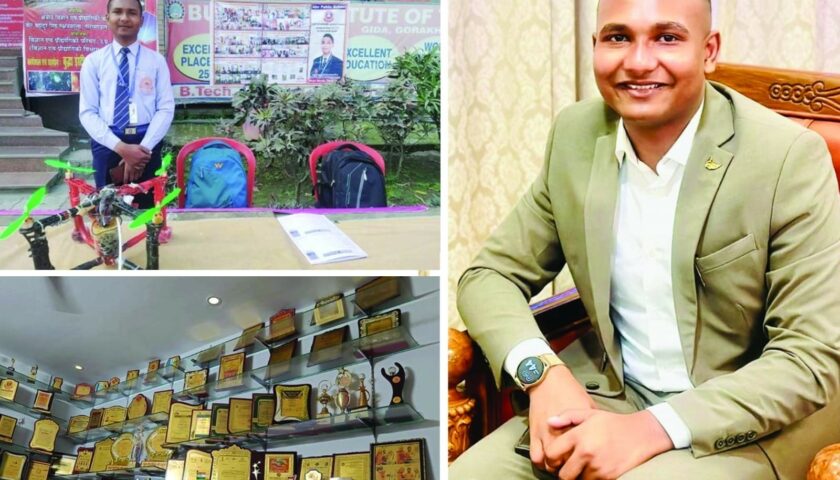
In the dusty lanes of Asman Chhapra, a small village in Uttar Pradesh, where poverty cast its long shadow over almost every household, a barefoot boy once played in the dirt. His clothes were worn, his resources limited—but his eyes carried an unusual sparkle. One day, as he looked up at the vast blue sky, he heard the distant sound of a helicopter cutting through the village silence. That sound did not frighten him; instead, it ignited a dream. The boy’s name was Rahul Singh.
Rahul was born to Sanjay Singh, a farmer-labourer who worked tirelessly from dawn to dusk in others’ fields and homes just to feed his family. Little did he know that his son was preparing not to cultivate soil, but to conquer the skies. His mother, Mrs. Rasmani Devi, despite severe financial hardship, filled their modest home with warmth, resilience, and hope. There was a shortage of money, but never a shortage of courage.
Rahul’s childhood was not filled with expensive toys or comforts. Instead, it revolved around scrap metal, discarded wires, broken motors, batteries, and damaged gadgets. While other children played, Rahul questioned—Why does this work? How does it function? He learned electricity, mechanics, sensors, and communication systems not from textbooks, but from real-life experimentation. Poverty did not suppress his curiosity; it sharpened it.
His extraordinary talent first gained recognition in 2017, when he won second prize at the Science Exhibition during the Maharajganj Festival. That moment marked a turning point. Rahul went on to participate in the India International Science Festival (IISF) in Lucknow and Kolkata, received an award on Dr. A.P.J. Abdul Kalam’s birth anniversary, and won first prizes at district and state levels in the National Child Science Congress. He showcased his innovations at prestigious platforms such as CSIR-CIMAP, Regional Science City, Lucknow, and the Gorakhpur Festival. By 2019 and 2020, he was consistently winning first prizes at the national level. These were not just trophies—they were proof that talent can rise even from the humblest beginnings.
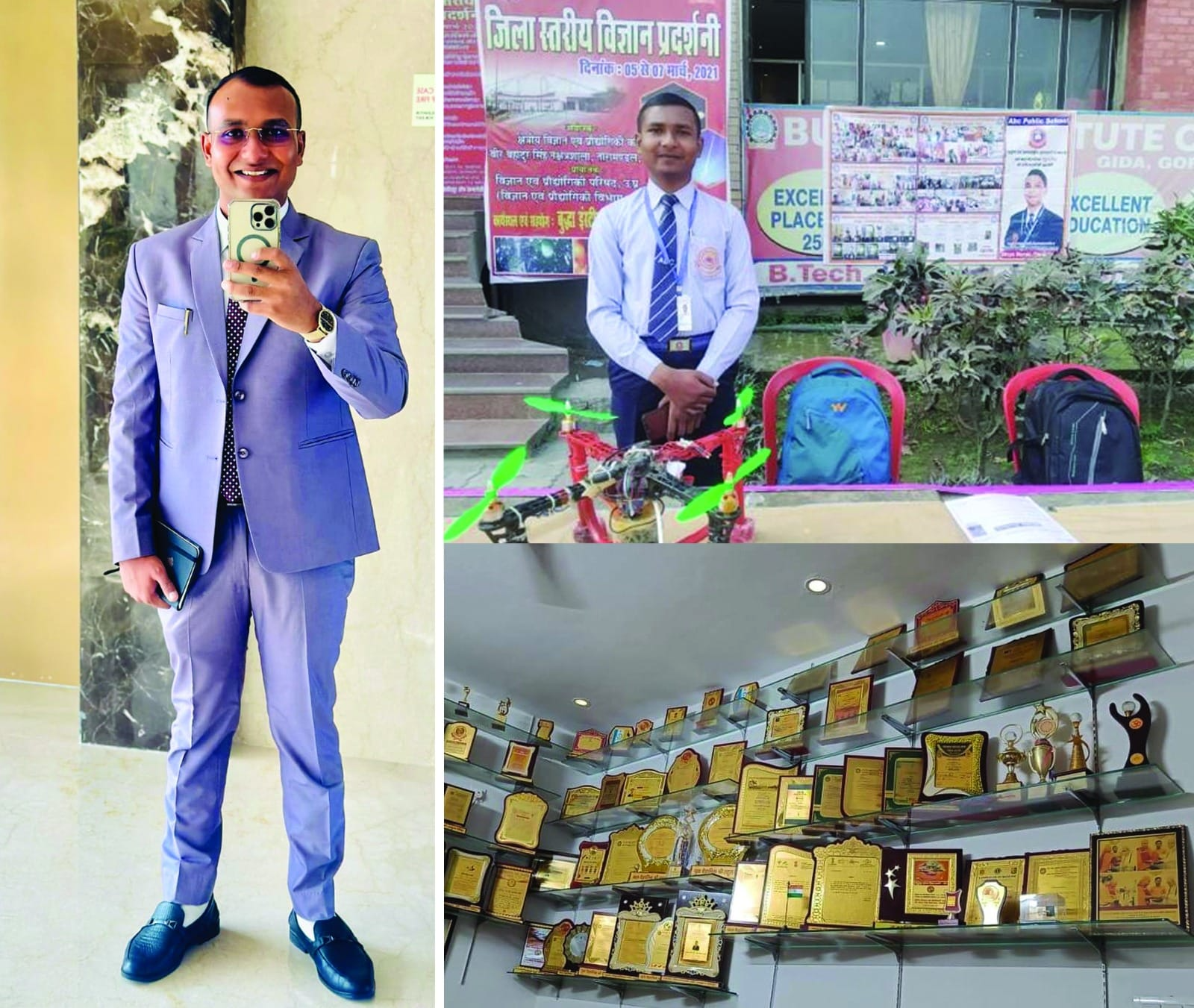
While the world largely viewed drones as recreational devices, Rahul saw them as powerful tools for transforming Indian agriculture. He envisioned drones as solutions to irrigation challenges, low-cost technology for farmers, and the extended eyes and hands of rural India. He developed affordable agricultural drones, energy-efficient generators, battery-operated farming equipment, sanitization machines during the COVID-19 pandemic, and machines for grass cutting and field tilling—all while still in his teens. His pockets were empty, but his commitment to serving poor farmers was unwavering.
Rahul later enrolled in the B.Tech program at Madan Mohan Malaviya University of Technology, Gorakhpur. His family and community felt reassured—believing his future was now secure. But Rahul chose a different path. He pursued knowledge over degrees, innovation over convention, and experimentation over comfort. Though he eventually dropped out of his B.Tech program, he never dropped out of learning, discipline, or determination. Today, he works as a successful drone innovator at the Design Innovation and Incubation Center, affiliated with the Uttar Pradesh Council of Science and Technology.
In the Mahabharata, Sanjay had the divine ability to witness the battlefield from afar. Today, the modern-day son of Sanjay—Rahul Singh—uses drones not only to observe challenges in agriculture, disaster relief, health, and safety, but to provide practical solutions. Every time his drone takes flight, it carries with it the dreams of countless children still living in fragile huts, surrounded by hardship and despair.
This is not merely the story of a B.Tech dropout—it is a powerful testament to hard work, courage, and unshakable self-belief. A degree may show the path, but determination takes you to the destination. When circumstances are harsh, dreams must become stronger. When resources are limited, mindset must become the greatest asset.
Rahul Singh stands as a symbol of new India—an India that dares to dream despite poverty. His journey proves that no matter how deep the hardship, the sky is never out of reach. His story moves us, inspires us, and sends a clear message to every underprivileged child:
“You too can fly.”
— Journalist: Priya Magarrati


