
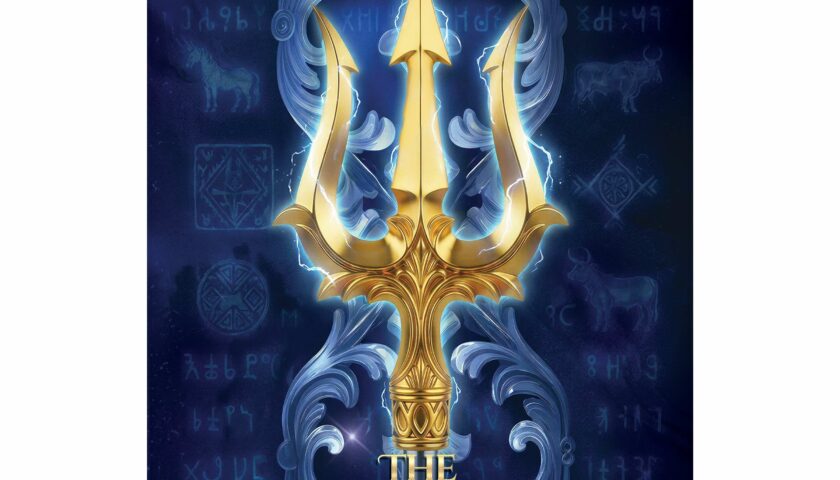
There is something inherently intriguing about the idea of knowledge that was never meant to be found. In Rahul Ajit Joshi’s debut book, Kaalnetra: The Trishul Chapter he builds on that premise to create a mythological techno-thriller that brings together ancient Indian history, archaeology, speculative science and conspiracy.
At the centre of this narrative is the legend of the Nine Unknown Men, whose origins in the aftermath of the Kalinga War form the novel’s foundation. Emperor Ashoka entrusts nine scholars with dangerous knowledge capable of influencing human consciousness. The knowledge is divided and concealed, protected across generations by bloodlines that exist outside the awareness of the modern world. At the heart of this centuries-old secret is the Trishul, an artefact associated with the warrior Rudra.
It then shifts from ancient India to the present day, where archaeology becomes the gateway to a history that has remained deliberately buried. An excavation in Rajasthan brings archaeologist Dr Priya Malhotra into contact with a mystery that extends far beyond a conventional archaeological discovery. Meanwhile, historian Dr Arjun Singh begins experiencing blackouts, visions and memories that appear to have a connection with an ancient guardian lineage. Their seemingly separate journeys gradually converge, drawing them into a network of secret organisations and forgotten histories.
The novel’s treatment of consciousness is particularly central to its larger conflict. The threat here is not simply the possession of a powerful object. The greater danger lies in the possibility of manipulating memory, belief and human thought. This gives the narrative a contemporary dimension, turning an ancient secret into a question about power and responsibility in an age increasingly shaped by technology.
The archaeological and historical elements also give the story a distinctly Indian setting while retaining the scale of an international conspiracy thriller. The locations of Rajasthan, the Himalayas, ancient sites and hidden chambers become part of a larger landscape of clues, bloodlines and concealed knowledge. The result is a narrative that draws from familiar thriller conventions but places Indian history and mythology firmly at their centre. Joshi’s cinematic approach to storytelling is evident in the construction of the novel.
At another level, Kaalnetra is concerned with the inheritance of knowledge, memory and responsibility. The bloodlines at the heart of the story are not simply a device for connecting the present to the past; they raise questions about whether destiny can be inherited and whether individuals have the right to walk away from a legacy they never chose.
For fans of Indian mythology, the novel offers a speculative reinterpretation of material that has long occupied the space between legend and historical imagination. For readers of archaeological and conspiracy thrillers, it provides a distinctly Indian mythology-driven setting. Its larger premise also leaves room for a wider fictional universe, with its multiple artefacts, bloodlines, organisations and unexplored histories.
With Kaalnetra: The Trishul Chapter, Rahul Ajit Joshi enters the mythology-fiction space with an ambitious attempt to connect India’s ancient past with questions surrounding technology, consciousness and power. Its central question remains deliberately provocative: what if some of the stories inherited as myths were once descriptions of knowledge that humanity was never supposed to rediscover?