
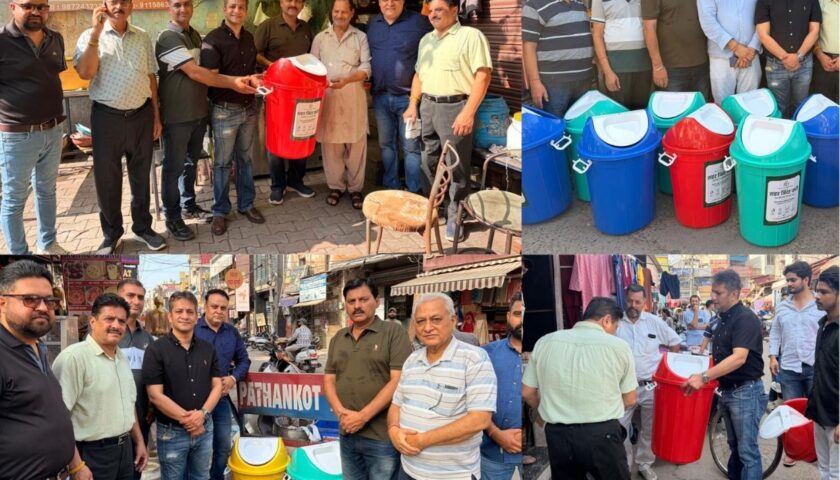
Pathankot’s streets are witnessing a quiet civic revolution. Under the banner of Shahar Zinda Karo, Srijal Gupta’s flagship citizen-led initiative, the city has entered a new and ambitious phase: the distribution of 500 dustbins across Pathankot’s bazaars, markets, and public spaces.
From a March to a Movement
The dustbin drive did not begin with a press release — it began with a march. Inspired by the spirit of the Dandi March, volunteers under Shahar Zinda Karo walked through Pathankot’s streets in the Zinda Kooch campaign, handing over the first dustbins directly to traders in the city’s bazaars. More than 100 volunteers walked shoulder to shoulder with shopkeepers and residents as part of the effort.
The campaign’s rallying cry captured the moment perfectly: “Iss 15 August, Kuda Toh Azaadi” — this Independence Day, freedom from garbage too. It reframed a civic gap as an act of collective liberation, tying the dustbin drive to the deeper Pathankot identity that Shahar Zinda Karo has consistently invoked.
The Numbers So Far
What started as a march has become a measurable mission. Seventy-five dustbins have already reached shopkeepers across Pathankot’s bazaars, each one handed over with the involvement of local volunteers and traders’ bodies. The target now stands firmly at 500 dustbins citywide — a scale that would touch nearly every major market corridor in Pathankot.
This phase, internally referred to as Shahar Sundar Karo (“Make the City Beautiful”), launched on Sunday, August 2, 2026, as the natural sequel to the “Zinda Karo” groundwork already laid. The philosophy is deliberate: a city must first be brought back to life — its civic infrastructure functioning, its public spaces cared for — before it can be made beautiful. Dustbins, in this framing, are not just municipal furniture; they are the first visible proof that a street belongs to someone again.
Built on a Track Record
The dustbin distribution does not stand alone. It follows a string of Shahar Zinda Karo interventions that have steadily rebuilt public trust in civic action across the city:
- The renovation of public toilets on Dalhousie Road
- Installation of 25 portable toilets across Pathankot’s markets, handed over to Beopar Mandal traders’ associations with dedicated volunteer caretakers
- The Shree Jal Abhiyan summer relief drive, providing ORS, lahori jeera, and caps to outdoor workers through the peak heat
- Emergency relief work that reached over 1,500 families during the 2025 Pathankot floods
This history matters. Permissions for public infrastructure work — including formal letters to the Deputy Commissioner for installations at Environment Park, Shimla Pahari, Dalhousie Road, Gurjeet Market, and the Veterinary Hospital — reflect an approach built on institutional coordination rather than ad-hoc activism. The dustbin campaign inherits that same discipline: SSP permissions, NGO partnerships, and market association buy-in have all been part of the groundwork.
The 25 portable toilets installed across Pathankot’s markets remain a defining marker of this approach. Rather than treating the installations as a one-time handover, Srijal Gupta ensured each unit was placed directly with the Beopar Mandal and staffed with dedicated volunteer caretakers — a model that made the traders’ body a genuine stakeholder rather than a passive recipient. That partnership has paid off in goodwill: the Beopar Mandal has been vocal in its praise of Srijal Gupta and the broader Shahar Zinda Karo initiative, holding it up as an example of civic work done in genuine partnership with the trading community rather than imposed upon it. That same trust is now being extended to the dustbin drive, with traders’ associations again standing alongside volunteers as the bins reach shopkeepers across the city.
Why Dustbins, Why Now
Pathankot’s bazaars generate waste every day that too often ends up on the street rather than in a bin — not for lack of civic will among shopkeepers, but for lack of a bin to use. By placing dustbins directly in traders’ hands, in the presence of their own market associations and volunteer caretakers, Shahar Zinda Karo is betting on ownership over enforcement. A dustbin gifted by a neighbour, in front of one’s own shop, tends to get used.
This is the quieter insight running through all of Srijal Gupta’s civic work: infrastructure alone does not change behaviour, but infrastructure handed over in person, through a relationship, often does. The toilets on Dalhousie Road, the portable units across the markets, the ORS and Lahori jeera distributed to outdoor workers during peak summer heat — each of these was designed as a handover, not a delivery. The dustbin campaign follows the same template, scaled up to 500 units and stretched across every major bazaar in the city.
The campaign’s earlier work has already drawn national press attention — coverage from ANI, PTI, Hindustan Times, IANS, and Business Standard followed the portable toilet installations. The dustbin drive, with its symbolic march and its concrete 500-unit target, is positioned to extend that visibility further, turning a municipal gap into a citywide civic story.
A Model Traders Trust
What sets Shahar Zinda Karo apart from a typical municipal cleanliness drive is the sequencing of trust before infrastructure. Long before the first dustbin was handed over, Srijal Gupta had already built a working relationship with Pathankot’s trading community through the 25 portable toilets — a project that required not just installation but ongoing maintenance, caretaking, and coordination with the Beopar Mandal. That groundwork meant the Zinda Kooch march did not arrive as an outside campaign asking shopkeepers to change their habits; it arrived as an extension of a partnership the Beopar Mandal had already endorsed.
That endorsement has been unambiguous. Traders who worked with Srijal Gupta on the toilet installations have continued to speak highly of him and of Shahar Zinda Karo more broadly, pointing to the caretaker model and the direct, hands-on handovers as proof that the initiative treats the trading community as a partner rather than a target audience for a photo opportunity. It is this credibility — earned bazaar by bazaar over successive campaigns — that is now smoothing the path for 500 dustbins to reach shopkeepers with minimal friction and maximum buy-in.
The Road to 500
With 75 dustbins already in place, the campaign has 425 to go — bazaar by bazaar, shop by shop. Each handover follows the same rhythm established during the Zinda Kooch march: volunteers arrive alongside market association representatives, a dustbin changes hands, and a shopkeeper who has watched Srijal Gupta’s earlier campaigns follow through is asked to do the same. It is a slow method by design, built for adoption rather than optics.
If the pace and partnerships established during the Zinda Kooch march hold, Shahar Zinda Karo’s dustbin distribution will stand as one of the most visible, ground-level civic infrastructure efforts Pathankot has seen in recent years — not government-mandated, but citizen-carried, one bin and one street at a time.
Shahar Zinda Karo — Pehle Zinda Karo, Phir Sundar Karo.