
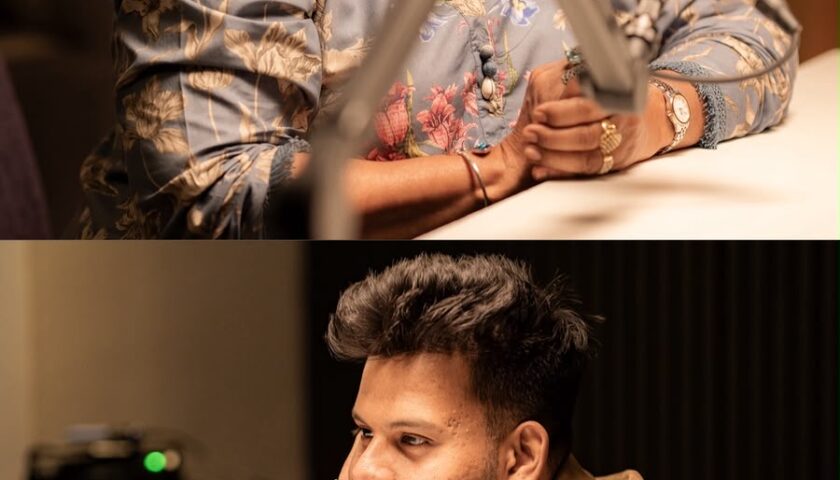
New Delhi, 13th Oct 2026: Dr. Ameenah Gurib-Fakim, who served as President of Mauritius from 2015 to 2018, believes the world has quietly left behind the era of a single dominant power. In a new episode of the Rustle Podcast, she tells host Abhinav Sharma that America’s “unipolar moment” has passed, and that the rise of India, China and a re-energised Russia is ushering in a multipolar order.
The 47-minute conversation, led by the podcast’s founder, ranges from a village classroom in Mauritius to the corridors of global diplomacy.
“I believe every successful leader has a story worth sharing, and every conversation has the potential to inspire someone to dream bigger,” said Sharma.
A multipolar world, and a fragile one
Gurib-Fakim traces America’s unipolar moment to the years after 2001, when China joined the World Trade Organization and the Soviet Union’s dissolution was still fresh. That period, she says, gave America “the sense that it can control the world,” until China’s economy grew to rival it. Today, she argues, India, China and Russia are no longer weak, and middle powers such as Canada are finding their own voice.
The catch, she cautions, is that a multipolar world tends to make the multilateral system more fragile, even as global challenges grow too large for any one country, especially a small one. She pointed to Washington’s 2026 withdrawal from 66 United Nations bodies, by her count, as a sign of that fragility, and argued the Security Council should better reflect India and Africa.
Asked about recent American actions involving Venezuela, Cuba and Greenland, she suggested that conflicts are increasingly about securing resources, adding that some “are not going the way it was planned.” She also noted that US national debt has crossed $40 trillion.
A small island’s perspective
Mauritius, she says, is often pictured only as sun and sea. The island has no army, yet it oversees an ocean territory of roughly 2.2 million square kilometres, the foundation of a growing “blue economy.” She sees it as a natural bridge between Asia and Africa, the world’s youngest continent, and speaks warmly of the deep ties between Mauritius and India.
From a newspaper headline to the presidency
Gurib-Fakim’s own path to office was anything but planned. The biochemist and entrepreneur, who says she had “no political ambition,” returned from an overseas trip to learn her name had been floated for the presidency. Her photograph ran in the newspaper the next morning. Supporters pointed to India’s scientist-president, Dr. A.P.J. Abdul Kalam, as a parallel, and she won in a landslide.
She recalls a village school with no laboratory, where teachers took students into forests and rivers to show them that “science is about life.” The move to a British university was “night and day.” Her response: “Sink or swim. I chose to swim.”
Highlights from the episode
- Roots in India: Using her OCI card, she traced her family to a village near Lucknow. Her ancestors left India in 1862, making her a fourth-generation Mauritian of Indian origin.
- Women and opportunity: Free education for girls, she says, opened many professions to women in Mauritius. Leave half your players on the bench and “you never win the football match.”
- A message to young people: India’s youth, she says, are driven and full of promise, and deserve the tools, jobs and trust to build the country’s future.
- Life at the top: Leadership can be “lonely,” she admits, but a clear purpose helps.
Her closing advice is simple: “The size of your dreams must scare you.”
Part of a wider conversation
The episode joins a guest list on Rustle Podcast that spans public life, business and technology. It includes former Union Health Minister Dr. Harsh Vardhan, former Uttar Pradesh Deputy Chief Minister Dinesh Sharma, former Facebook India Managing Director Kirthiga Reddy, Balaji Wafers founder Chandubhai Virani and former Tata Motors Managing Director Ravi Kant.
About the guest
Dr. Ameenah Gurib-Fakim is a biodiversity scientist and the first woman professor at the University of Mauritius, where she later served as dean and deputy vice-chancellor. She founded a plant-research enterprise before serving as President of Mauritius from 2015 to 2018.
About the host and podcast
Abhinav Sharma is the founder of Rustle Podcast, an emerging platform for meaningful conversations with leaders, policymakers, business pioneers and influential personalities from India and around the world. Driven by a passion for learning from accomplished people, he shares their experiences, challenges and achievements with audiences, particularly the younger generation.
His vision is to grow Rustle into a globally recognised platform that carries India’s voice to the world, and over time to feature world leaders, heads of state, global business figures and influential thinkers. “Rustle is more than a platform for interviews,” he says. “It is a mission to inspire the next generation, connect India with the world, and create conversations that leave a lasting impact.”
The full episode is available on the Rustle Podcast YouTube channel: https://youtu.be/kOBkyv-DcT8?si=TLwTJ7hOzVAWoheq