
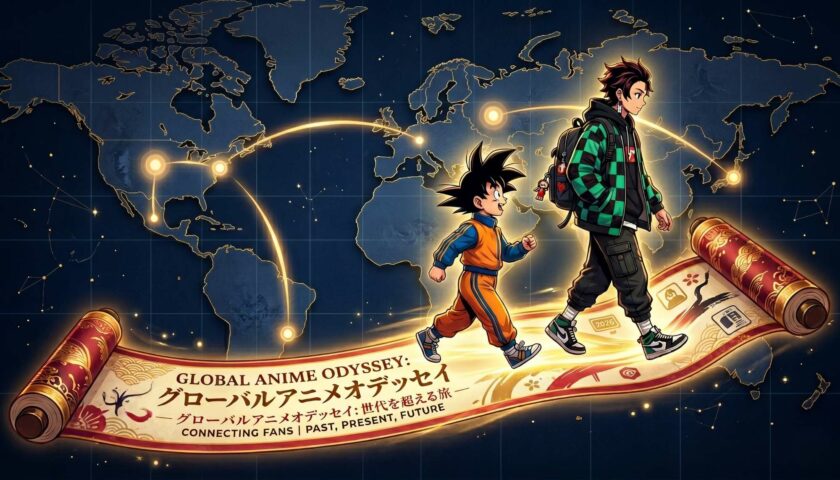
New in-depth research reveals how Japanese animation has evolved from a niche hobby into a $34.9 billion global cultural force — transforming the lives of both older nostalgic fans and the digitally-native new generation across India, the United States, Brazil, and beyond.
A sweeping new analysis of global anime consumption trends confirms what millions of fans across four continents already know: anime is no longer a subculture. It is the culture. From the living rooms of Mumbai to the convention halls of São Paulo, from New York City bedrooms to rural towns across Europe, Japanese animation has become one of the most unifying entertainment forces of the modern era — and it is doing something no other medium has quite managed: it is bringing generations together rather than pushing them apart.
The global anime market is anticipated to reach approximately $34.9 billion in 2026, with industry projections pointing to nearly $79 billion by 2036. Overseas anime revenues jumped an extraordinary 26% year-on-year in 2024 alone, confirming that international audiences have officially surpassed Japan’s own domestic market in economic value. These numbers represent more than financial growth — they represent a fundamental shift in how the world consumes stories.
India: From Doordarshan to Demon Slayer
Perhaps nowhere is this generational shift more vivid than in India. Adults in their 30s and 40s today grew up watching Hindi-dubbed Doraemon and Dragon Ball Z on Cartoon Network and Hungama TV — consuming anime without even knowing it was anime. For them, these shows were simply beloved childhood memories, emotional anchors tied to a simpler time.
Their children, however, are a different story. India’s Gen Z anime fans watch simulcast Japanese releases with subtitles, debate manga lore on Discord, buy imported merchandise, and attend AnimeIndia conventions. India’s anime market is growing at a 10.5% CAGR, and Crunchyroll’s own president has declared South Asia as “the future of anime” — a statement that reflects both the commercial opportunity and the extraordinary depth of passion Indian fans bring to the medium.
The United States: From Counterculture to Pop Culture Mainstream
In the United States, the transformation has been equally dramatic. The generation that grew up with Toonami in the late 1990s — staying up late to watch Gundam Wing and Sailor Moon on Cartoon Network — built anime fandom in America from the ground up. They organized the first conventions, built the first fan communities, and imported DVDs before legal streaming even existed.
Today, their successors have inherited a fully mainstream culture. An estimated 70% of Gen Z in the U.S. watches anime, with roughly 50 million American viewers engaged with the medium. Anime references saturate hip-hop, sports, fashion, and social media. The North American anime market is expected to grow at over 15% CAGR through 2033 — the fastest rate of any region in the world.
Brazil: 100 Million Reasons to Pay Attention
Brazil and Latin America represent perhaps the most underappreciated story in global anime. The region is home to an estimated 100 million anime fans, with Brazil at the center. Saint Seiya — known locally as Os Cavaleiros do Zodíaco — achieved a cultural penetration in Brazil in the 1990s that rivals anything seen in the West. The passion never faded. Today, Brazil hosts some of the world’s largest anime events outside Japan, and Brazilian cosplayers, fan artists, and content creators have built massive international audiences.
Why It Matters
What makes anime’s global rise genuinely significant — beyond box office numbers and streaming statistics — is its unique multigenerational appeal. It is one of the very few entertainment formats that a parent and child can discover together, argue passionately about, and love for entirely different reasons. A 45-year-old nostalgic for Dragon Ball Z and a 15-year-old obsessed with Jujutsu Kaisen are, in a very real sense, part of the same cultural conversation.
As AI-assisted production tools reduce costs, as Indian and Brazilian animators begin producing their own hybrid works, and as streaming platforms invest billions in exclusive anime content, the medium is entering a new and more complex phase — one defined not just by Japan, but by the entire world that has claimed it.
Anime does not belong to one country anymore. It belongs to every generation willing to watch.
About the Source : This analysis was originally published on MyAnimeThoughts, a dedicated platform covering anime culture, global fandom trends, series reviews, and industry insights for fans of every generation. For the full article and data breakdown, visit www.myanimethoughts.com.
Website: www.myanimethoughts.com | Insta: @myanimethoughts_ | FB: myanimethought