
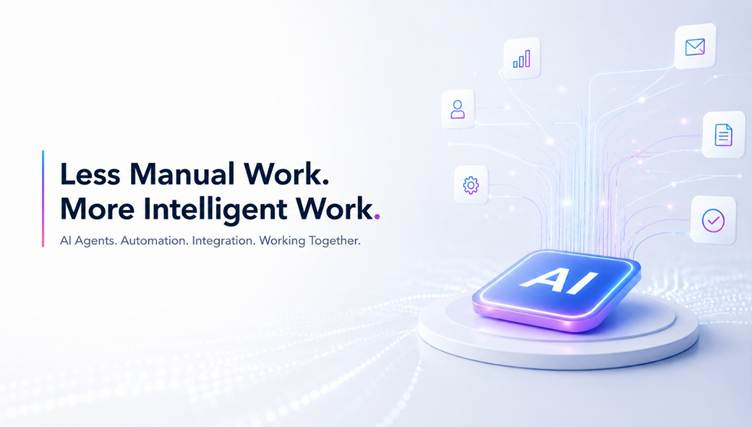
The biggest transformation AI may bring to businesses is not the ability to generate better content, analyse documents or answer questions in seconds. It may be something much more fundamental: removing the repetitive work that employees have been performing for years.
Across industries, businesses have invested heavily in digital tools to improve productivity. Sales teams use CRM platforms, marketing teams work with campaign and email systems, finance teams depend on accounting software and spreadsheets, while operations teams often use internal portals and specialised applications. Each system serves a purpose, but they rarely operate as one connected environment.
The result is a familiar problem inside many organisations. Employees continue to move information manually from one platform to another, update the same information in multiple systems, send emails to trigger the next step and maintain spreadsheets because different applications do not communicate with each other. What was originally intended to improve efficiency can gradually create another layer of operational complexity.
This is where AI, automation and integration are beginning to change the way enterprises think about digital transformation.
According to Deloitte research published in 2025, 87 percent of surveyed manufacturers had initiated a Generative AI pilot, demonstrating the speed at which AI is entering industrial environments. However, adopting AI and automating business processes are two very different things.
For many organisations, the next opportunity is therefore not to introduce another AI application. It is to make the software they already use work together and allow repetitive processes to run automatically.
This is the space in which Yugasa Software Labs Private Limited has been working with businesses, helping automate marketing, sales and operational activities through AI agents, real time automation and software integration.
The Software Chaos Inside Enterprises
Most businesses did not intentionally create fragmented technology environments. These systems evolved over many years as individual departments adopted tools to solve specific problems.
A CRM was introduced for sales. An email platform was added for marketing. An internal portal was developed for operations. Spreadsheets continued to be used for reporting and information management.
The problem begins when employees become the connection between these systems.
A salesperson may update a CRM and then share the same information with another department through email. Someone else may copy it into a spreadsheet, while another employee updates an internal portal.
The information is digital, but the process remains manual.
This creates delays, duplication and the possibility of inconsistent information. More importantly, it consumes employee time that could be spent on activities requiring human judgement and expertise.
AI Should Remove Work
The real promise of AI agents is not simply that they can produce intelligent responses. Their greater value emerges when they can understand information, make decisions based on business rules and initiate actions across connected systems.
Consider sales automation.
When a new enquiry arrives, an AI powered workflow can understand the enquiry, capture the relevant information, update the CRM, classify the lead, assign it to the appropriate salesperson, send an acknowledgement and create a follow up task.
Instead of an employee coordinating several individual actions, the process can execute automatically.
The same principle can be extended to marketing and operational workflows where repetitive activities occur regularly.
AI Alone Does Not Automate a Business
The growing popularity of AI has also created a misconception that using a native feature inside ChatGPT, Claude or another AI platform can automatically transform an entire business process.
An AI model can analyse information, generate content and assist with decision making. But enterprise processes involve multiple applications, databases, permissions, business rules and actions.
The intelligence therefore needs to be connected to execution.
AI provides the intelligence.
Automation provides the execution.
Integration connects the systems.
Without this integration layer, organisations can simply end up adding another intelligent tool to an already complicated software environment.
Yugasa’s Approach to Intelligent Automation
Yugasa Software Labs has been working with customers to identify repetitive activities across marketing, sales and operations and convert them into connected automated workflows.
The company uses technologies such as n8n, cloud platforms, ChatGPT and other AI agents to connect existing business tools and automate processes around them.
The objective is not necessarily to replace the software that a company already uses. Instead, the focus is on making those systems communicate and work together more intelligently.
Discussing this approach, Ashish Mittal, CEO at Yugasa Software Labs, shared his experience of implementing automation for large enterprises and his vision for the future of workplace processes.
According to Mittal, organisations have spent years digitising individual departments. The next major opportunity is to connect those digital systems so that information can move automatically and actions can happen without continuous human intervention.
He believes the combination of AI and automation can fundamentally change workplace processes across industries by shifting employees away from repetitive execution and towards higher value activities.
The Future Is Less Manual
The future of enterprise AI should not simply mean more applications, more dashboards and more tools for employees to manage.
It should mean fewer manual steps.
When software communicates with software, information can move faster. When AI can understand and automation can execute, repetitive activities can run on their own.
For businesses, this can mean greater efficiency, faster response times and better use of human talent.
The real promise of AI is therefore not simply creating more intelligent software.
It is creating workplaces where unnecessary work gradually disappears.