
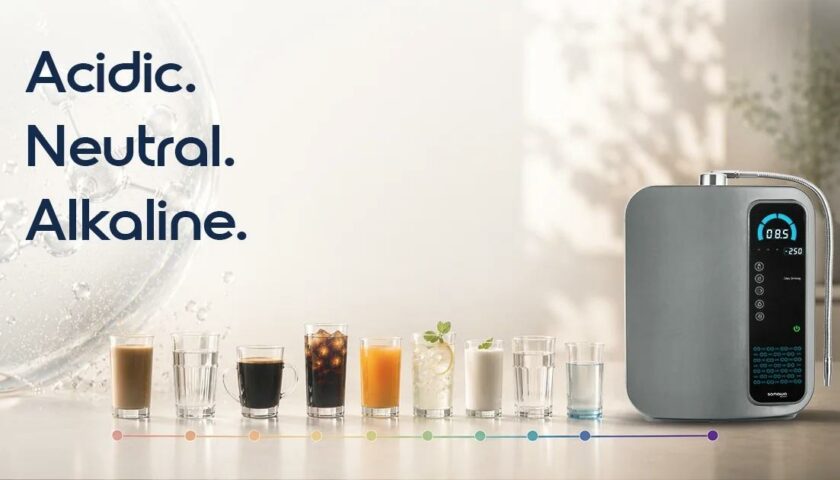
New Delhi, August 2026: Most Indians think of water as neutral. It is not. Municipal tap water in Indian cities typically sits between pH 6.5 and 7.5 depending on the source. After an RO membrane removes dissolved minerals — including calcium and magnesium — the pH drops further, often to between 5.5 and 6.5. The water that comes out of most Indian kitchen filters is mildly acidic by the time it reaches the glass.
SOMAWA, institutionally backed and incubated by NRDC — National Research Development Corporation, an enterprise of DSIR under the Ministry of Science and Technology, Government of India — has published a detailed beverage pH guide mapping the full picture of what an Indian household drinks across a typical day. The numbers are more striking than most readers expect.
Cola sits at pH 2.3 to 2.5 — tens of thousands of times more acidic than neutral water. Black coffee at 4.8 to 5.1. Packaged juice at 3.3 to 4.0. Nimbu paani at 2.5 to 3.0. Even chai — perhaps the most consumed beverage in India — sits at 6.2 to 6.8, below neutral. Chaas, often considered restorative, measures 4.4 to 4.8 due to its lactic acid content.
The body is exceptionally good at managing blood pH. It stays between 7.35 and 7.45 regardless of what is consumed — regulated continuously by the kidneys and lungs. This is the most common objection raised to alkaline water, and it is technically accurate: drinking alkaline water does not change blood pH. That is not the question the SOMAWA guide raises.
The question the guide asks is about workload. When the overwhelming majority of what a person drinks is acidic, the organs tasked with maintaining the body’s narrow alkaline window work continuously to compensate. The kidneys buffer excess acid through bicarbonate systems. The lungs adjust carbon dioxide output. The guide asks: is there a cost to that continuous corrective work — and is it avoidable?
RO filtration produces clean water. It removes lead, arsenic, bacteria — contaminants that have no place in a glass. But the membrane that removes lead cannot distinguish it from calcium or magnesium. Both are removed with equal efficiency. The result is water that is chemically clean and minerally depleted — and typically sits at pH 5.5 to 6.5. SOMAWA water starts at pH 8.5 because it operates from a different mechanism entirely: it supercharges the calcium and magnesium already present in the source water rather than stripping the water to then add chemicals back.
The full guide includes the complete beverage pH table, the science behind each reading, a comparison of water sources by pH and mineral content, and a plain-language explanation of what the BIS standard for Indian drinking water actually says about pH. Every claim in the guide is indexed to a peer-reviewed source.
“We built this guide because we kept meeting families who had never been shown the actual numbers. Once you see that your nimbu paani sits at pH 2.5 and your RO water at pH 6.0 — you start asking different questions about what you put in your body every single day.”
— Gitanshu Mittal, Founder, SOMAWA
The full guide is available at somawa.com/journal/ph-of-everything-you-drink.
About SOMAWA
SOMAWA is a luxury water wellness brand and the only water ionizer company in India institutionally backed and incubated by NRDC (National Research Development Corporation), an enterprise of DSIR under the Ministry of Science and Technology, Government of India. SOMAWA water delivers a minimum of 1,500 parts per billion of dissolved molecular hydrogen with a pH starting at 8.5, designed to hydrate deeply while retaining the natural minerals water was always meant to carry. The brand’s range — Modish, Amara, Amara NXT, Udaka, and Toya — serves households across India with indigenously manufactured ionizers engineered for Indian water conditions, backed by a service infrastructure across 500+ cities.
Disclaimer: SOMAWA products are wellness devices, not medical treatments. Nothing in this article constitutes medical advice. SOMAWA does not claim to cure, treat, or prevent any condition. SOMAWA is institutionally backed and incubated by NRDC (National Research Development Corporation), an enterprise of DSIR under the Ministry of Science and Technology, Government of India.